International Name Formats: Western vs Eastern Name Order

International Name Formats

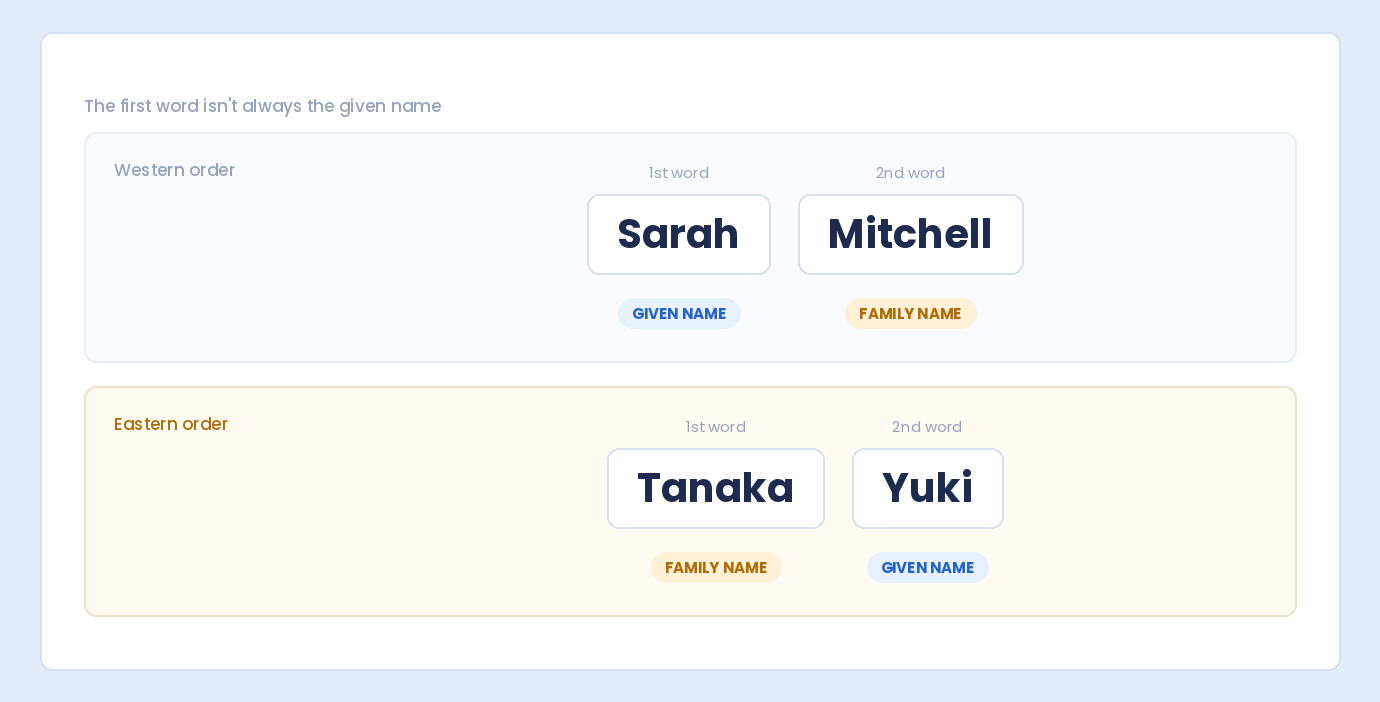
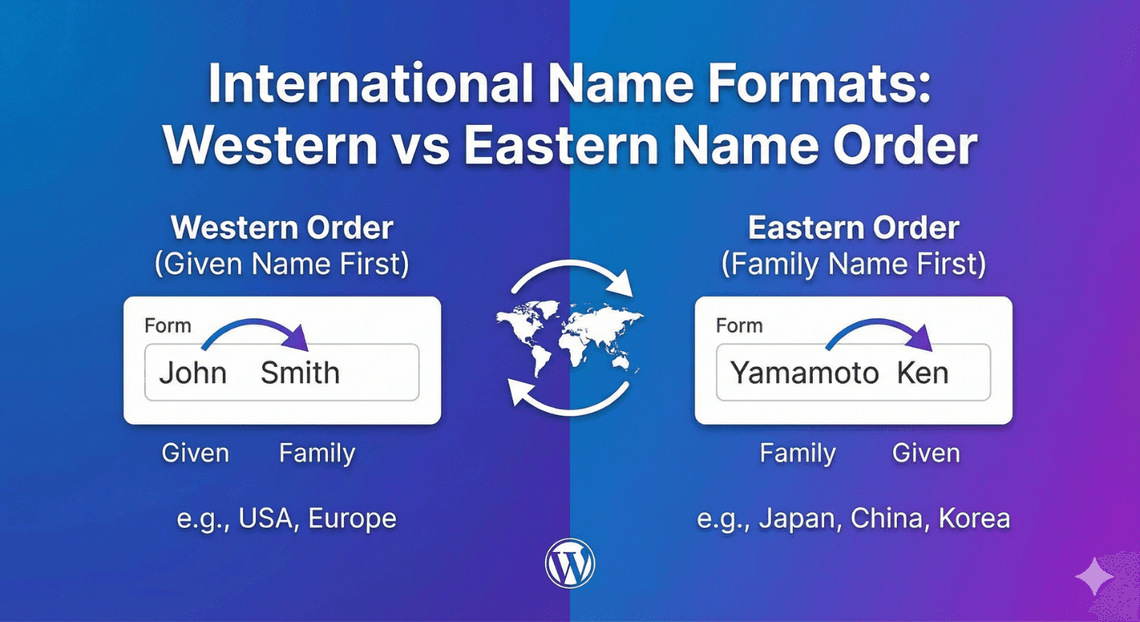
In the West, we say “John Smith”—given name first, family name last. In much of Asia, it’s the opposite: “Smith John” puts the family name first. If your forms assume everyone uses Western name order, you’re confusing—and potentially offending—a significant portion of the world.

In this guide, you’ll learn about international name formats and how to create forms that work for users from any culture.

Understanding Name Order Differences

Western Name Order

Structure: Given Name + Family Name

Example: John Smith

  • Given name (first name): John
  • Family name (surname/last name): Smith

Eastern Name Order

Structure: Family Name + Given Name

Example: 山田 太郎 (Yamada Tarō)

  • Family name: Yamada (山田)
  • Given name: Tarō (太郎)

Why It Matters

  • Addressing someone incorrectly is disrespectful
  • Database sorting may be wrong
  • Mail merge and communications fail
  • User experience suffers

Name Order by Region

Western Name Order (Given + Family)

Region Countries/Examples
North America USA, Canada, Mexico
Western Europe UK, France, Germany, Spain, Italy
Australia/NZ Australia, New Zealand
South America Brazil, Argentina, Chile
Most of Africa Nigeria, South Africa, Kenya
Middle East Most countries (with variations)
South Asia India, Pakistan (generally)

Eastern Name Order (Family + Given)

Region Countries/Examples
East Asia China, Japan, Korea, Vietnam
Southeast Asia Cambodia, parts of others
Hungary Eastern European exception

Examples by Country

Country Order Example Family Name Given Name
USA Western John Smith Smith John
UK Western Emma Watson Watson Emma
China Eastern 李明 (Li Ming) Li (李) Ming (明)
Japan Eastern 田中 花子 (Tanaka Hanako) Tanaka Hanako
Korea Eastern 김민수 (Kim Minsu) Kim (김) Minsu (민수)
Vietnam Eastern Nguyễn Văn An Nguyễn An
Hungary Eastern Nagy István Nagy István

The Problem with “First Name / Last Name”

Confusing Labels

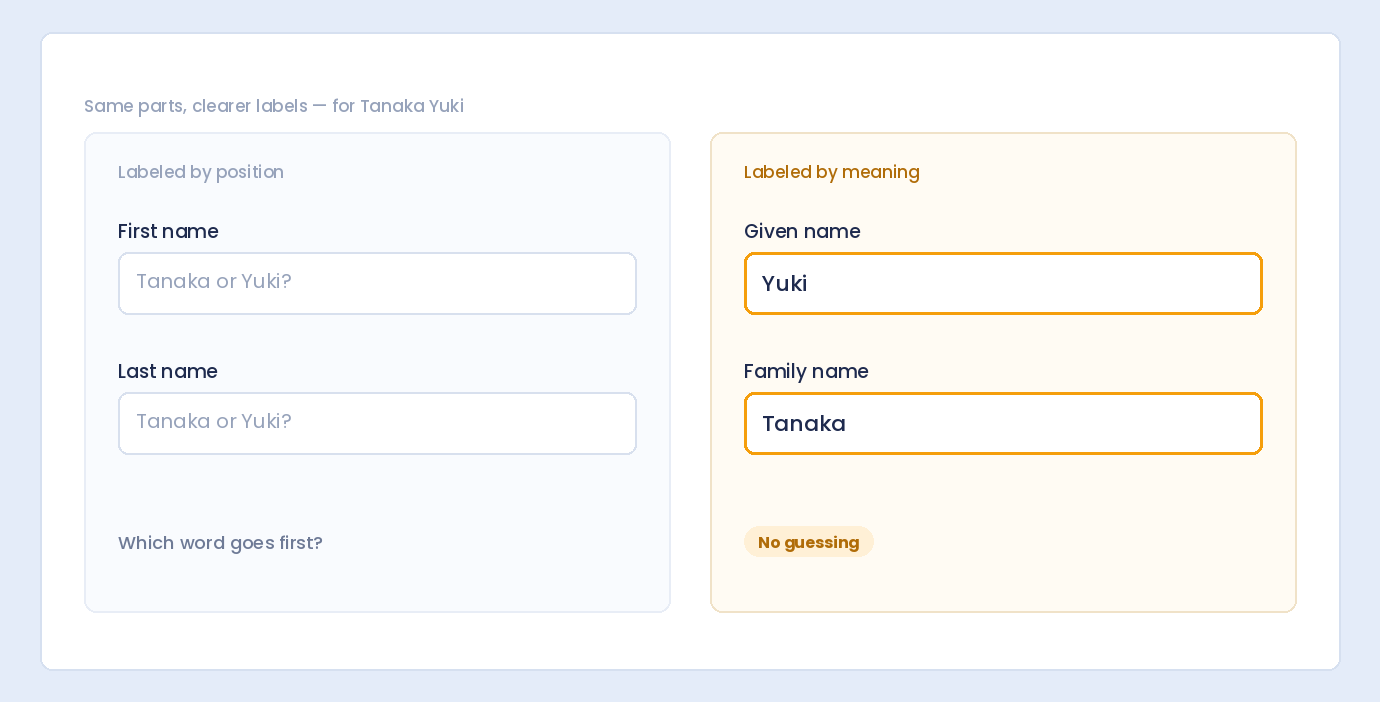
The labels “First Name” and “Last Name” assume Western order:

  • “First” = First in Western order (given name)
  • “Last” = Last in Western order (family name)

For Eastern name order users:

  • Their “first” name is actually their family name
  • They may enter names in wrong fields
  • Or reverse their name to fit the form

Real-World Confusion

Example: Japanese user Tanaka Hanako

  • Family name: Tanaka
  • Given name: Hanako

Sees form asking:

  • First Name: [____]
  • Last Name: [____]

Possible responses:

  1. Enter Japanese order: First = “Tanaka”, Last = “Hanako” ❌
  2. Reverse to Western: First = “Hanako”, Last = “Tanaka” ✓
  3. Get confused and abandon form

Better Approaches for International Forms

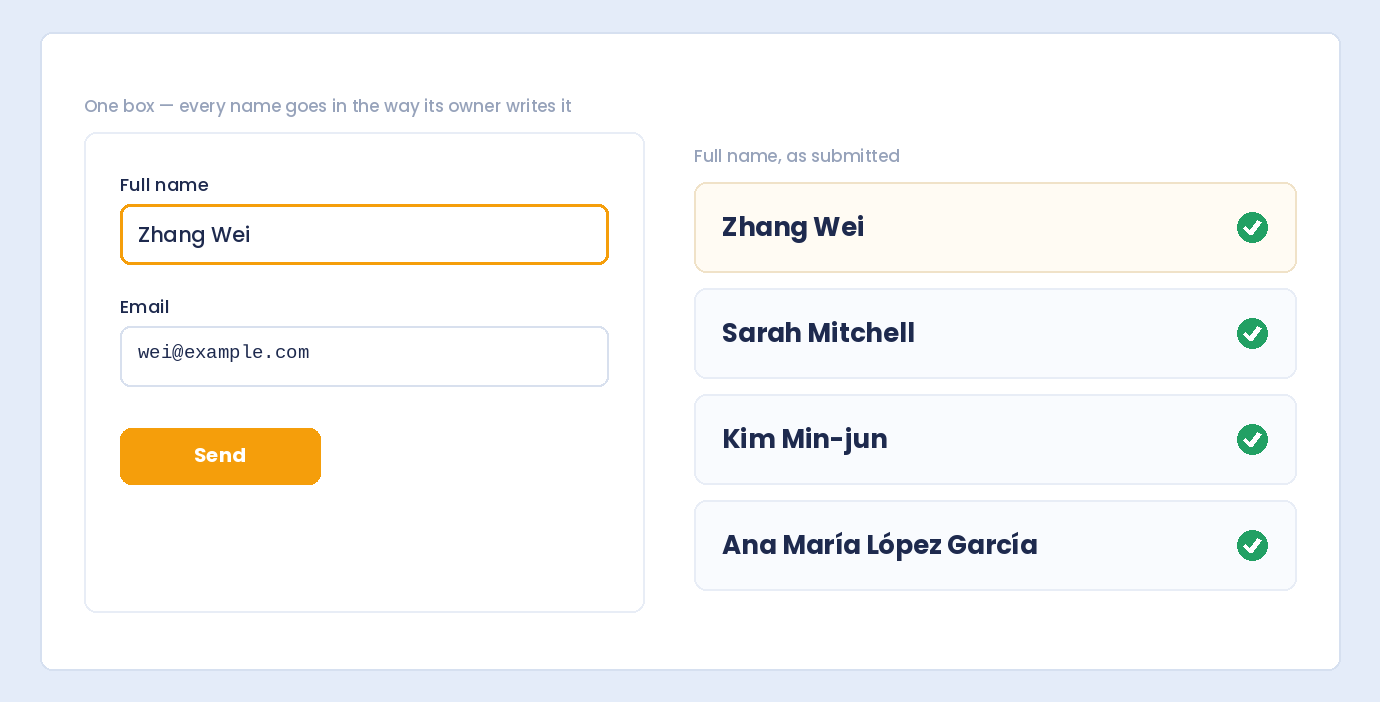
Option 1: Single Full Name Field

Label: “Full Name” or “Name”

Pros:

  • No order confusion
  • Users enter name naturally
  • Works for all cultures
  • Simplest approach

Cons:

  • Can’t sort by family name
  • Can’t address by given name only
  • Parsing is difficult

Best for: Simple contact forms, newsletters

Option 2: Given Name / Family Name Labels

Labels:

  • “Given Name” (instead of First Name)
  • “Family Name” (instead of Last Name)

Pros:

  • Unambiguous meaning
  • Works regardless of cultural order
  • Proper database storage

Cons:

  • Less familiar to some Western users
  • Requires slight education

Best for: International forms, global audiences

Option 3: Name Format Selection

Let users choose their format:

  • [ ] Western (Given Name + Family Name)
  • [ ] Eastern (Family Name + Given Name)

Then adjust field order or interpretation accordingly.

Pros:

  • Respects user preference
  • Explicit about order

Cons:

  • Adds complexity
  • Extra question for users

Option 4: Country-Based Adaptation

If collecting country:

  • User selects country
  • Form adjusts name field order/labels
  • China selected → Family Name first
  • USA selected → Given Name first

Pros:

  • Automatic adaptation
  • Feels natural to user

Cons:

  • Complex to implement
  • Doesn’t help diaspora users

Configuring Name Fields in Auto Form Builder

Auto Form Builder supports different name formats:

Step 1: Add Name Field

  1. Drag Name field to your form
  2. Click to open settings

Step 2: Choose Name Format

Select the appropriate format:

Western Format

  • Given Name (First) + Family Name (Last)
  • Standard for Western audiences

Eastern Format

  • Family Name + Given Name
  • Appropriate for East Asian audiences

Formal Format

  • Prefix + Given Name + Family Name + Suffix
  • For professional/formal contexts

Step 3: Customize Labels

Change field labels as needed:

  • “First Name” → “Given Name”
  • “Last Name” → “Family Name”
  • Or localized equivalents

Step 4: Consider Single Field Option

For simplicity:

  • Use single “Full Name” field
  • Avoid order issues entirely

Special Cases and Variations

Mononyms (Single Names)

Some cultures use single names:

  • Indonesian names (Suharto, Sukarno)
  • Some South Indian names
  • Celebrities/artists

Solution: Don’t require both fields; allow single name entry.

Multiple Family Names

Spanish-speaking cultures often have two family names:

  • Paternal family name + Maternal family name
  • Example: Gabriel García Márquez
  • García = paternal, Márquez = maternal

Solution: Allow longer family name field or multiple fields.

Patronymic Names

Icelandic names don’t use family names:

  • Björk Guðmundsdóttir = Björk, daughter of Guðmund
  • Not a family name in traditional sense

Solution: Flexible fields, don’t assume family name inheritance.

Religious/Caste Names

Some Indian names include:

  • Religious names
  • Village/caste identifiers
  • May appear in different positions

Solution: Allow flexibility, don’t force structure.

Name Changes in International Context

Many East Asians adopt Western names:

  • Jackie Chan (陳港生, Chan Kong-sang)
  • May use different names in different contexts

Solution: Consider “Preferred Name” field.

Database and Display Considerations

Storage Strategy

Option A: Separate Fields

  • given_name: “Hanako”
  • family_name: “Tanaka”
  • name_order: “eastern” or “western”

Option B: Single Field + Components

  • full_name: “Tanaka Hanako”
  • Store as entered

Display Logic

When showing names:

  • Formal lists: Use family name order (Tanaka, Hanako)
  • Informal greeting: Use given name (Hi Hanako!)
  • Full display: Respect original order

Sorting

Alphabetical sorting by family name is common:

  • Works well if family name is separate field
  • Problematic with single field unless parsed

Best Practices for International Name Fields

1. Use Unambiguous Labels

Prefer “Given Name” and “Family Name” over “First” and “Last”:

  • Clear meaning regardless of culture
  • Prevents confusion

2. Don’t Force Structure

Allow flexibility:

  • Single name (mononym) should be possible
  • Very long names should fit
  • Special characters allowed

3. Consider Single Field for Simple Needs

If you just need a name for greeting:

  • One “Full Name” field suffices
  • Avoids all ordering issues

4. Add Help Text

Clarify what you’re asking:

  • “Your personal/given name”
  • “Your family/surname”
  • “Enter name as you’d like to be addressed”

5. Test with International Users

Have people from different cultures try your form:

  • East Asian users
  • Users with complex names
  • Identify confusion points

6. Respect What’s Entered

Don’t auto-correct or reformat:

  • Don’t capitalize unexpectedly
  • Don’t trim perceived “extra” names
  • Store exactly as entered

Examples of Inclusive Name Forms

Simple Contact Form

  • Name: [Full name field]
  • Email: [Email field]
  • Message: [Textarea]

One name field—no order confusion.

Account Registration (International)

  • Given Name: [Text] (Your personal name)
  • Family Name: [Text] (Your surname)
  • Display Name: [Text] (How you want to be addressed)

Clear labels plus preference option.

Formal Application

  • Family Name: [Text]
  • Given Name(s): [Text] (All given/middle names)
  • Name as shown on ID: [Text]

Family name first (common in formal contexts).

Frequently Asked Questions

Should I use “First Name” or “Given Name”?

“Given Name” is more internationally accurate. “First Name” assumes Western name order. For global audiences, “Given Name” and “Family Name” are clearer.

What if users enter names in wrong order?

With clear labels (Given Name/Family Name), this is less likely. If using First/Last, some Eastern name order users may reverse their names to fit.

Is one name field enough?

For simple forms (newsletters, contact), yes. For systems needing to address people properly or sort alphabetically, separate fields are better.

How do I handle names with special characters?

Allow Unicode characters. Names may include accents (José), umlauts (Müller), non-Latin scripts (田中), and more. Don’t strip or convert these.

What about middle names?

Include optional middle name field, or allow multiple given names. Some cultures don’t use middle names at all.

Summary

Handling international name formats:

  1. Understand differences – Western (Given + Family) vs Eastern (Family + Given)
  2. Use clear labels – “Given Name” and “Family Name” instead of First/Last
  3. Consider single field – “Full Name” avoids ordering issues
  4. Allow flexibility – Mononyms, long names, special characters
  5. Add help text – Clarify what each field means
  6. Test internationally – Get feedback from diverse users
  7. Respect entries – Store names as entered

Conclusion

Names are deeply personal and culturally significant. A form that assumes everyone uses Western name order alienates half the world. By using clearer labels, offering flexibility, or simplifying to a single field, you create forms that welcome everyone.

Auto Form Builder supports multiple name formats—Western, Eastern, and Formal—plus customizable labels. Create name fields that work for your audience, whether local or global.

Ready for internationally-friendly forms? Download Auto Form Builder and configure name fields that respect every culture.

Leave a Reply

Your email address will not be published. Required fields are marked *