Email Confirmation: Prevent Typos with Double Entry

Email Confirmation

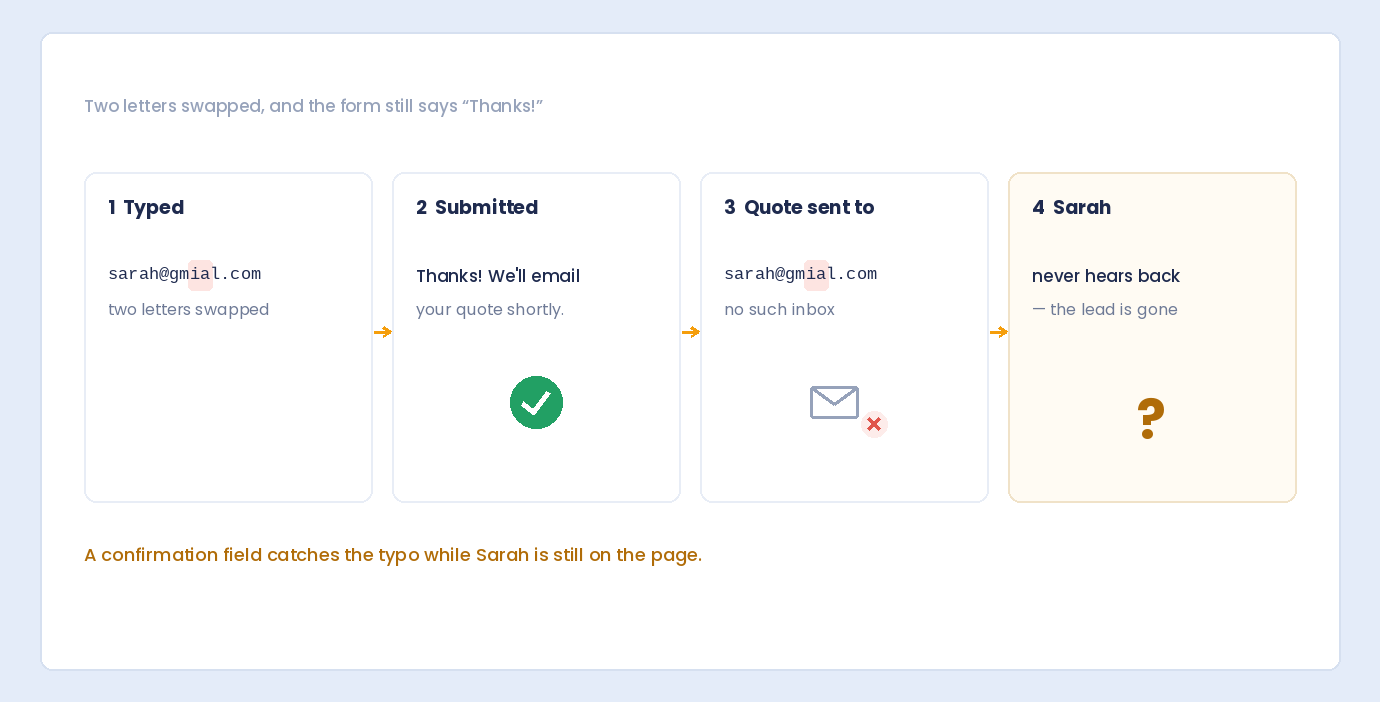
A single typo in an email address means lost customers. They never receive your confirmation, your follow-up, or your newsletter. And you’ll never know why they didn’t respond.

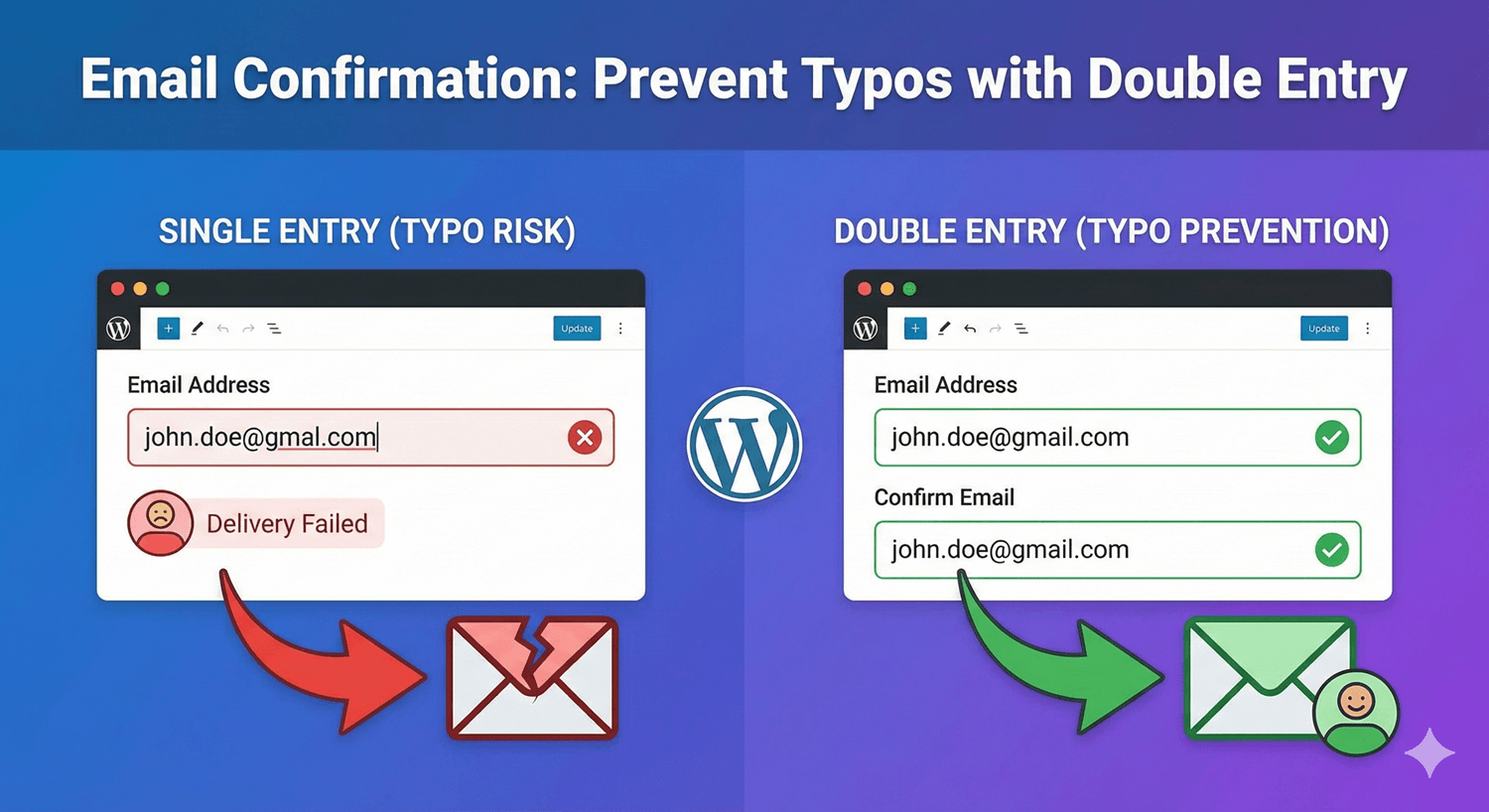
Email confirmation fields solve this problem by asking users to enter their email twice. If the entries don’t match, they can’t submit the form.

In this guide, you’ll learn why email confirmation matters and how to add it to your WordPress forms.

The Cost of Email Typos

Email typos happen more often than you’d think:

  • Fat finger errors: “gmial.com” instead of “gmail.com”
  • Missing characters: “john@example” instead of “[email protected]
  • Transposed letters:[email protected]” instead of “[email protected]
  • Auto-correct mishaps: Mobile keyboards “helping” with wrong suggestions
  • Copy-paste errors: Incomplete selection when pasting

Studies suggest that 2-5% of email addresses entered in forms contain errors. For a form with 1,000 submissions per month, that’s 20-50 lost contacts.

What You Lose

  • Sales: Order confirmations bounce, customers think you’re ignoring them
  • Leads: Follow-up emails never arrive
  • Subscribers: Newsletter welcome emails go nowhere
  • Support: Help responses never reach the customer
  • Accounts: Password reset emails can’t be delivered

How Email Confirmation Works

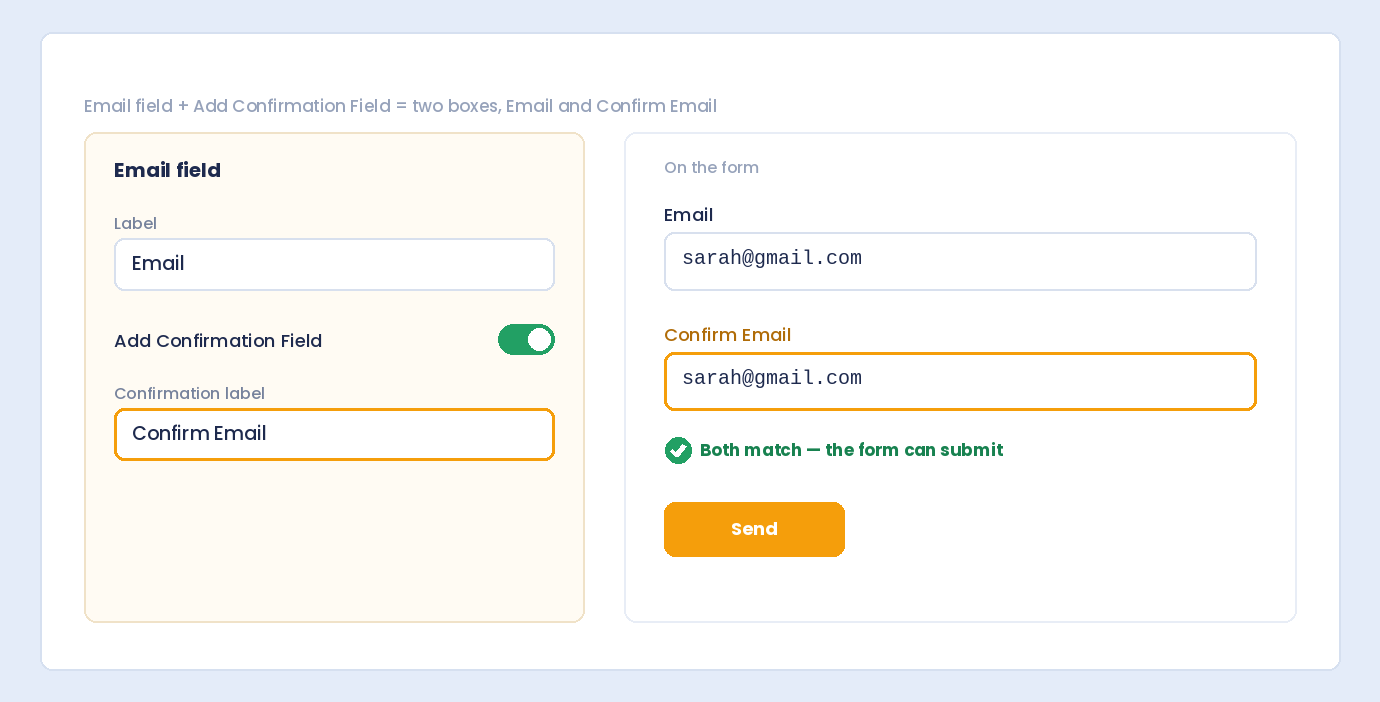
Email confirmation adds a second email field to your form:

  1. User enters email in the first field: [email protected]
  2. User enters email again in the confirmation field: [email protected]
  3. Form compares both entries
  4. If they match → form submits
  5. If they don’t match → error message, user must fix it

The simple act of typing the email twice catches most typos. Users are forced to look at what they’re typing rather than rushing through.

When to Use Email Confirmation

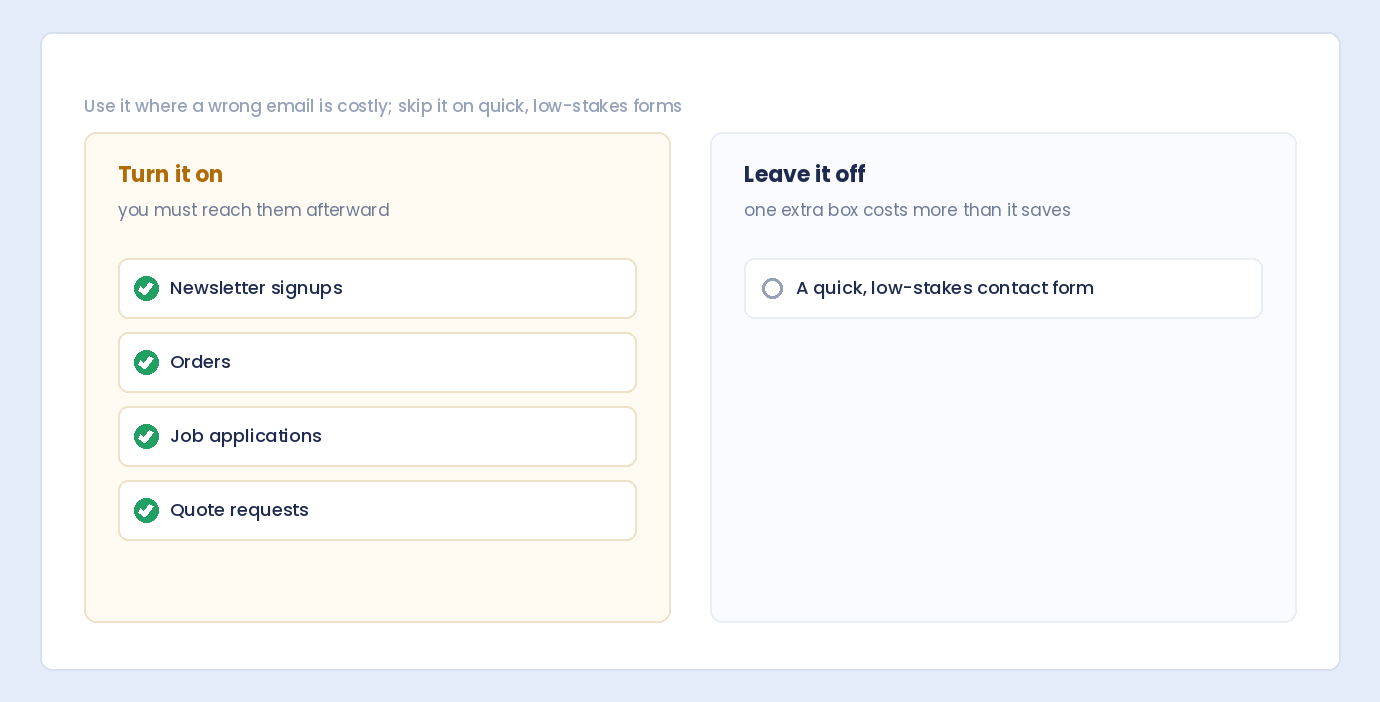
Email confirmation adds friction to your form. Use it when the email address is critical:

✅ Use Confirmation For:

  • Account registration – Users need to verify their account
  • Newsletter signups – You’re building a mailing list
  • Order forms – Receipts and shipping info go to this address
  • Support tickets – Your response depends on reaching them
  • Event registration – Tickets and reminders are emailed
  • Job applications – Interview invitations must arrive
  • Quote requests – Your proposal needs to reach them

❌ Skip Confirmation For:

  • Quick contact forms – Low-stakes inquiries
  • Feedback forms – One-time communication
  • Simple surveys – Anonymous or optional email
  • Forms where email is optional – Not critical to the process

The rule: If a wrong email means lost business or frustrated customers, use confirmation.

Setting Up Email Confirmation in WordPress

Here’s how to add email confirmation with Auto Form Builder:

Step 1: Install Auto Form Builder

  1. Go to Plugins → Add New in WordPress
  2. Search for “AFB” (the short name for Auto Form Builder)
  3. Find “AFB – Auto Form Builder – Drag & Drop Form Creator
  4. Click Install Now, then Activate

Step 2: Add an Email Field

  1. Create a new form or edit an existing one
  2. Drag the Email field from the sidebar onto your form
  3. Click the email field to open its settings

Step 3: Enable Confirmation

In the Email Field settings:

  1. Find the “Confirmation Field” option
  2. Toggle it ON

That’s it! Auto Form Builder automatically:

  • Adds a second email field labeled “Confirm Email”
  • Validates that both entries match
  • Shows an error if they don’t match

Step 4: Customize Labels (Optional)

You can customize the field labels:

  • Email field label: “Email Address”
  • Confirmation label: “Confirm Email Address”

Or use friendlier language:

  • Email: “Your Email”
  • Confirmation: “Re-enter Your Email”

Step 5: Add Help Text (Optional)

Add instructions to guide users:

  • “Please double-check your email address”
  • “We’ll send your confirmation to this address”
  • “Make sure both email fields match”

Best Practices for Email Confirmation

1. Place Fields Together

Keep the email and confirmation fields next to each other. Don’t separate them with other fields—users should see them as a pair.

2. Use Clear Labels

Make it obvious why there are two fields:

  • Good: “Email Address” + “Confirm Email Address”
  • Good: “Your Email” + “Re-type Your Email”
  • Bad: “Email” + “Email 2” (confusing)

3. Show Helpful Error Messages

When emails don’t match, the error should be clear:

  • Good: “Email addresses don’t match. Please check both fields.”
  • Bad: “Validation error” (not helpful)

4. Disable Paste on Confirmation Field

Some forms disable pasting in the confirmation field. This forces users to type the email again rather than copy-paste (which would copy any typos too).

Note: This can frustrate users with password managers. Use with caution.

5. Consider Mobile Users

Typing an email twice on mobile is tedious. For mobile-heavy audiences:

  • Keep fields short and clear
  • Use appropriate input type (email keyboard)
  • Consider if confirmation is truly necessary for your use case

Common Email Typos to Watch For

Even with confirmation, some typos slip through (users make the same mistake twice). Here are the most common:

Domain Typos

Wrong Correct
@gmial.com @gmail.com
@gmai.com @gmail.com
@gamil.com @gmail.com
@yahho.com @yahoo.com
@yahooo.com @yahoo.com
@hotmal.com @hotmail.com
@outloo.com @outlook.com

Format Errors

  • Missing @ symbol: johnexample.com
  • Missing .com: john@example
  • Extra spaces: [email protected]
  • Double @: john@@example.com

Auto Form Builder’s email validation catches format errors automatically. Confirmation catches typos that still result in valid-looking addresses.

Alternative: Domain Restriction

For some use cases, you can restrict which email domains are allowed:

Company/Organization Forms

Only allow company email addresses:

  • Whitelist: @yourcompany.com
  • Block: Personal emails (gmail, yahoo, etc.)

How to Set Domain Restrictions

In Auto Form Builder’s Email Field settings:

  1. Find “Domain Restriction” option
  2. Enable Domain Whitelist
  3. Add allowed domains (e.g., yourcompany.com)

Users with non-whitelisted domains will see an error and cannot submit.

You can combine domain restriction with email confirmation for maximum accuracy.

Email Confirmation + Other Validation

Email confirmation works alongside other validation features:

Required Field

Mark the email field as required. Users can’t skip it.

Format Validation

Auto Form Builder automatically validates email format (must have @ and domain).

Domain Restriction

Limit to specific domains if needed.

All Together

For maximum email accuracy:

  1. Required field ✓
  2. Format validation ✓ (automatic)
  3. Confirmation field ✓
  4. Domain restriction (optional)

What Happens When Emails Don’t Match

When a user enters mismatched emails:

  1. Form submission is blocked
  2. Error message appears near the confirmation field
  3. Both email fields remain visible so user can compare
  4. User corrects the typo and resubmits

The user experience is smooth—they immediately understand the problem and can fix it.

Testing Your Email Confirmation

Before launching, test these scenarios:

Test Cases

Scenario Expected Result
Matching emails Form submits successfully
Different emails Error: “Emails don’t match”
First email empty Required field error
Confirmation empty Error: Fields must match
Same typo in both Form submits (can’t catch this)
Different case (John vs john) Should match (email is case-insensitive)

Frequently Asked Questions

Does email confirmation slow down form completion?

Yes, slightly. Users spend a few extra seconds typing their email twice. But this small friction prevents larger problems (bounced emails, lost contacts). For critical forms, it’s worth it.

Should I disable copy-paste on the confirmation field?

It depends. Disabling paste forces users to type again (catching more typos), but frustrates users with password managers. Test with your audience.

What if users make the same typo twice?

Confirmation can’t catch this. It’s rare, but it happens. For truly critical emails (account creation), consider sending a verification email as an additional check.

Are emails case-sensitive?

Email addresses are technically case-insensitive ([email protected] = [email protected]). Auto Form Builder treats them as matching regardless of case.

Can I use confirmation with other email features?

Yes! Confirmation works with required validation, format validation, and domain restrictions. Use them together for maximum accuracy.

Summary

Email confirmation is a simple feature with big benefits:

  1. Catches typos before they cause problems
  2. Saves lost contacts from email bounces
  3. Improves deliverability of your follow-ups
  4. Takes seconds to enable in Auto Form Builder

Use it on forms where email accuracy matters: signups, orders, registrations, and support requests.

Conclusion

A wrong email address is a missed opportunity. Email confirmation adds one extra step for users but saves countless lost connections.

With Auto Form Builder, enabling email confirmation takes one click. Your users type their email twice, the form checks for matches, and you get accurate contact information.

Ready to prevent email typos? Download Auto Form Builder and enable email confirmation on your forms today.

Leave a Reply

Your email address will not be published. Required fields are marked *