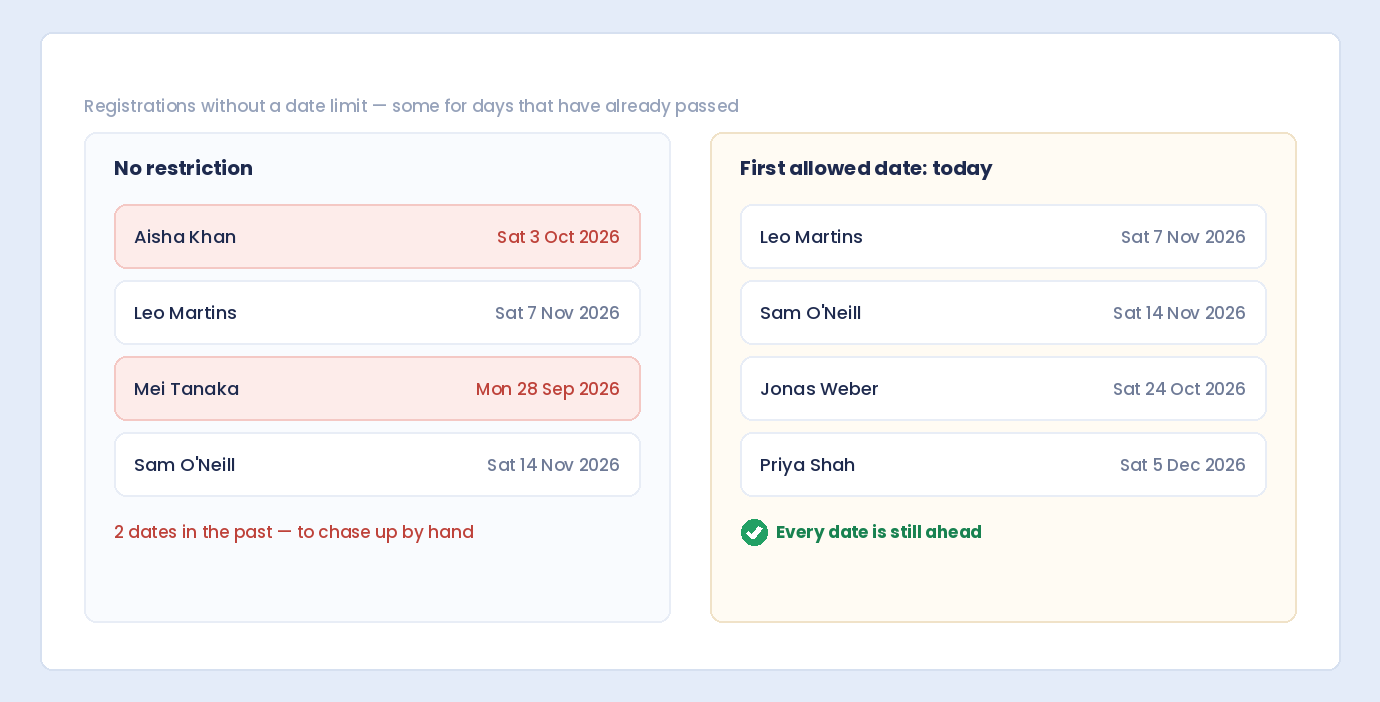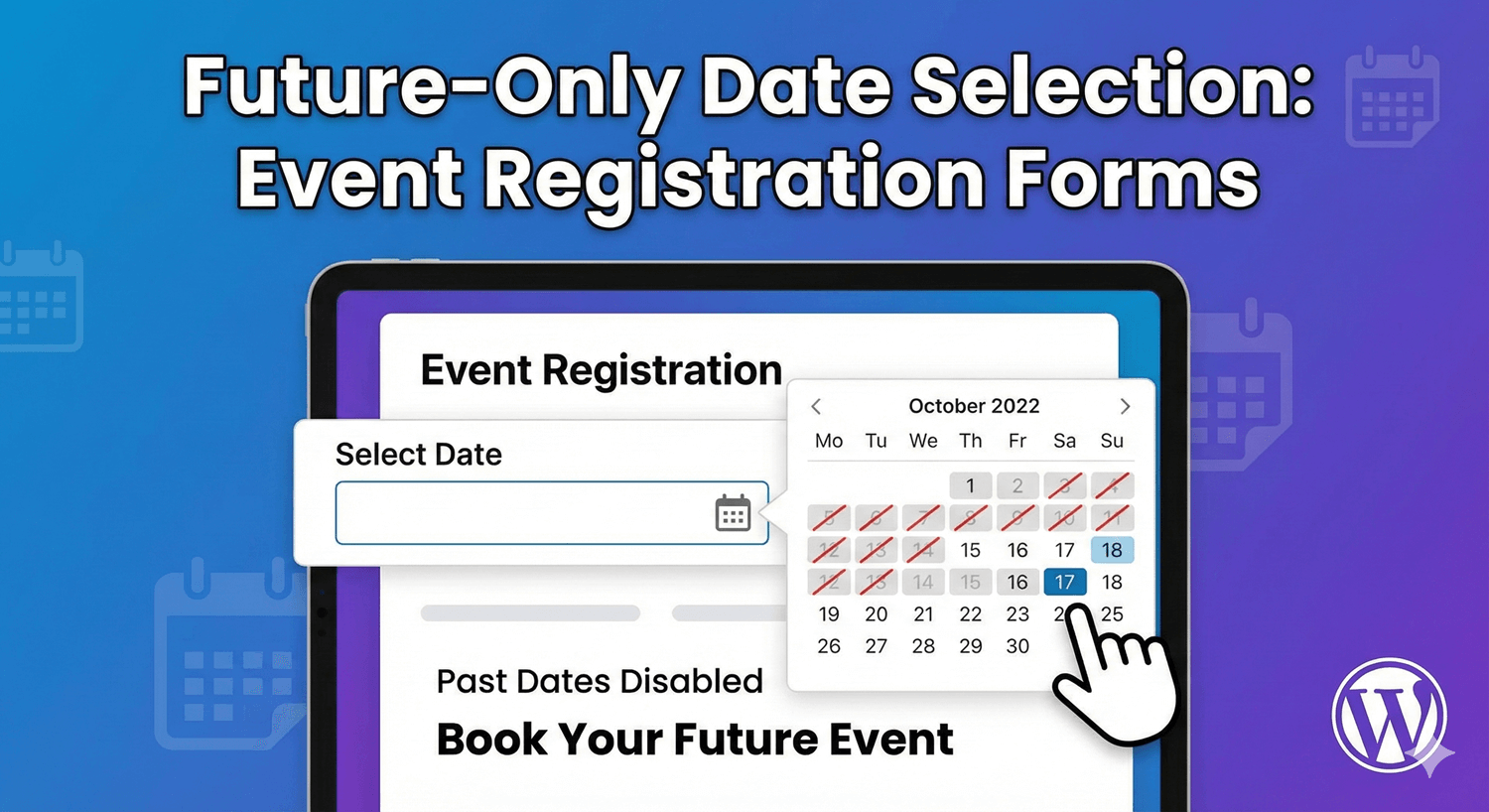
Event registration forms need dates that make sense — attendees should not pick yesterday for a workshop, and registrations should close before the event ends. Without date restrictions, you get invalid signups, scheduling conflicts, and manual cleanup in your inbox. Auto Form Builder includes a full-featured Date field with Block Past Dates, custom min/max ranges, weekend blocking, and server-side validation — so respondents can only select valid future dates for event registration, appointments, and bookings. Last updated: Last update 18 August Event and registration forms commonly need these date rules: Auto Form Builder enforces these rules in the browser (via HTML5 date constraints) and on the server when the form is submitted — so manipulated requests cannot bypass your restrictions. The fastest way to allow only today and future dates is to enable Block Past Dates in the Date field settings. When checked: This setting updates automatically each day — “today” is always calculated at render and submission time, so yesterday’s date becomes blocked without you editing the form. Best for: open-ended event registration where any future date is valid — workshops, consultations, volunteer signups, and general RSVP forms. For events with a defined registration period, use First Allowed Date and Last Allowed Date alongside or instead of Block Past Dates.
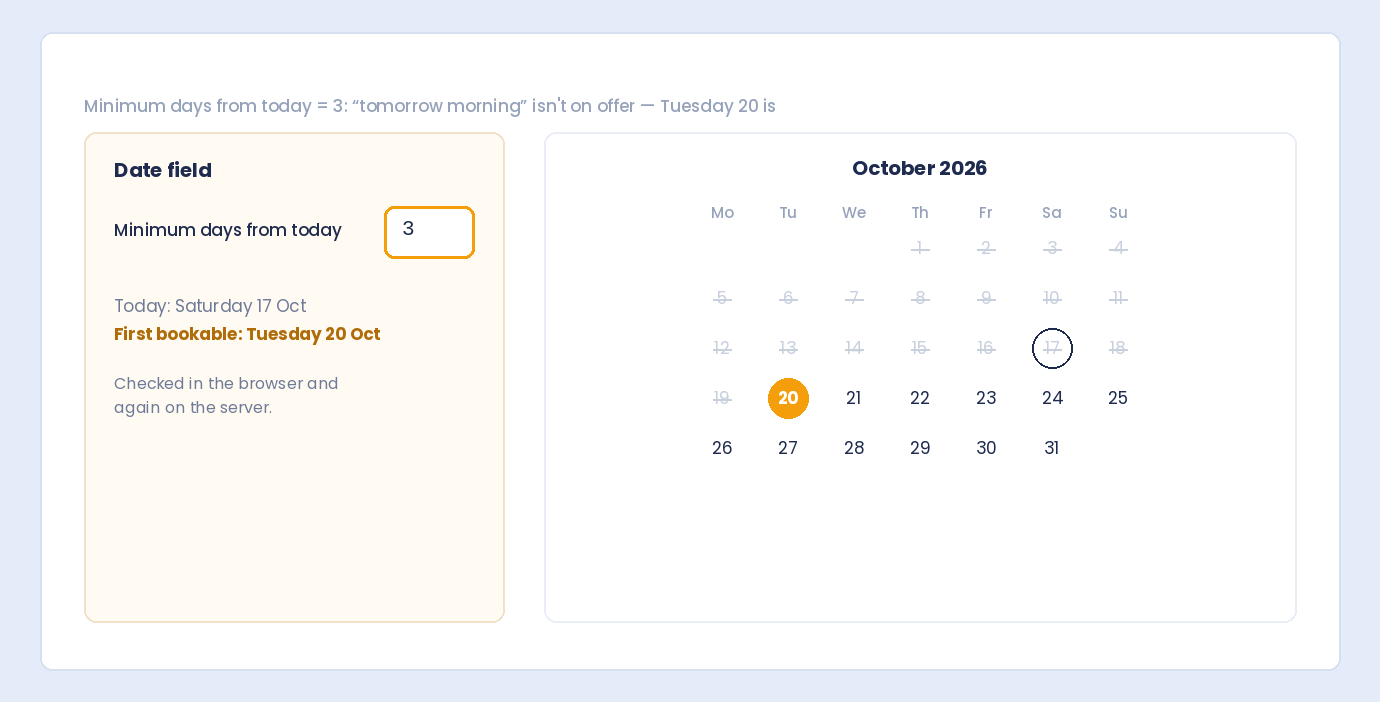
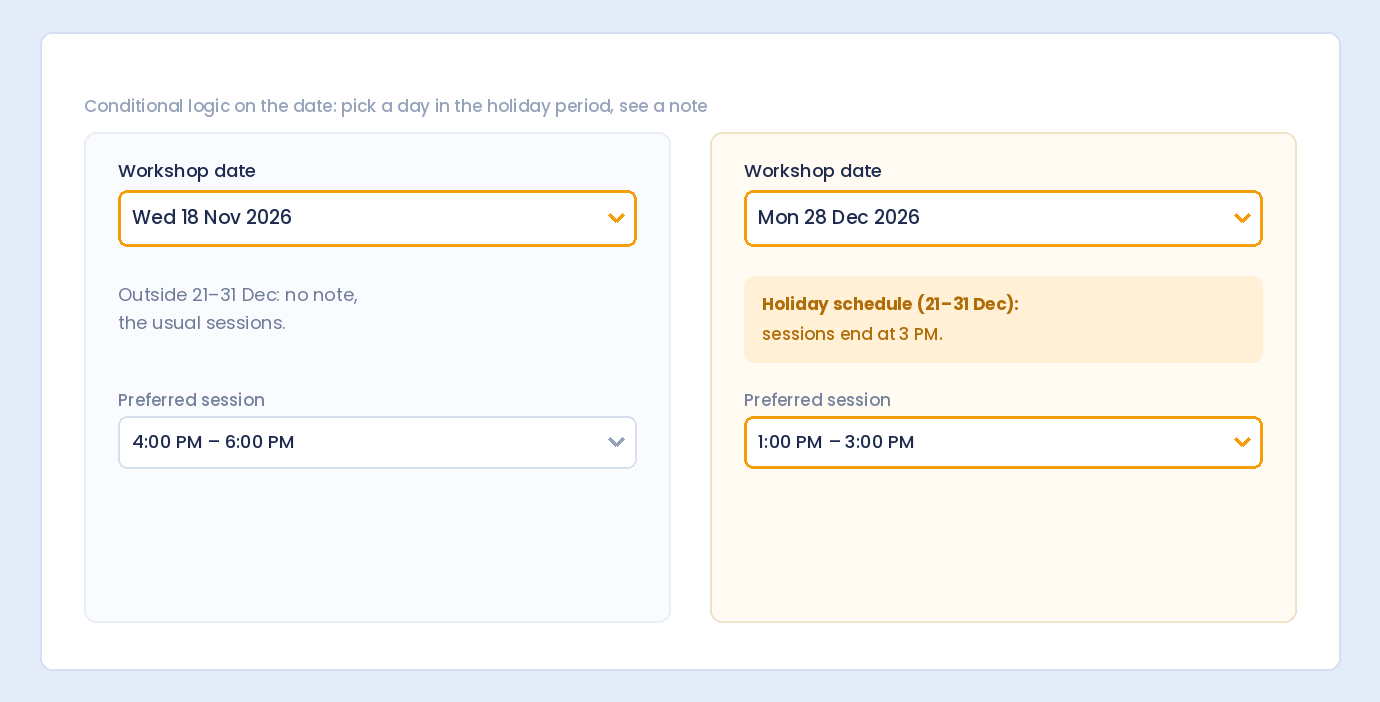
Click the Today button in settings to quickly set the minimum to today’s date, or pick any specific date from the calendar. Sets the latest date respondents can select. Use this as a registration deadline or to limit selections to dates before your event ends. When both Block Past Dates and First Allowed Date are set, Block Past Dates takes priority for the minimum — the effective minimum is whichever is later: today or your First Allowed Date. Validation messages for out-of-range dates: Running weekday workshops or business-hour appointments? Enable No Weekend Selection in the Date field settings. When a respondent selects a Saturday or Sunday: If a default starting date falls on a weekend, the field automatically moves it to the next Monday. Combine with Block Past Dates for business event registration — future weekdays only. Choose the date format your audience expects: The selected format controls how dates appear in the preview chip below the input. Submitted dates are stored consistently and formatted in email notifications and the submissions inbox according to your field settings. Pre-select a default date when the form loads: By default, a human-readable preview (e.g., “Apr 16, 2026”) appears next to the date input as respondents select a date. Disable Show date preview chip if you prefer a cleaner layout. Auto Form Builder’s Event Registration template provides a solid starting point with Full Name, Email, Phone, Number of Guests, and Special Requirements fields. Add a Date field for event date selection: Combine with a Time field if attendees also choose a session time slot. Date restrictions are enforced twice — in the browser and on the server: Even if someone bypasses the browser picker and submits a manipulated date value, the server rejects it with a clear error message before the submission is saved. Not every registrant needs to pick a date. Use conditional logic to show the date field only when relevant: Enable Conditional Logic on the Date field and set your conditions with AND or OR logic. Date fields with Block Past Dates, min/max ranges, weekend blocking, format options, and server-side validation are all included in the free Auto Form Builder plugin — along with the Event Registration template and full submissions management. Install from WordPress.org: https://wordpress.org/plugins/auto-form-builder/ Last updated: Last update 18 August Auto Form Builder lets you create multi-step forms, calculators, and lead capture forms in WordPress, then embed them on any site with a single line of code. Add a Date field and enable Block Past Dates in the Date Field Options. Respondents can only select today or future dates. Server-side validation enforces the same rule on submission. Yes. Set Last Allowed Date to your registration or event end date. Dates after that limit are blocked in the picker and rejected on the server. Yes. Enable No Weekend Selection. Saturday and Sunday dates are auto-adjusted to the next Monday on the frontend and rejected by server validation if submitted manually. Yes. The minimum date is calculated as today using your WordPress site timezone at render and submission time — no manual form updates needed. ISO (YYYY-MM-DD), US (MM/DD/YYYY), UK (DD/MM/YYYY), and European with dashes (DD-MM-YYYY). Choose the format in How to Display Dates in the field settings. Yes. Past dates, future dates, min/max ranges, and weekend restrictions are all re-validated server-side when the form is submitted. The Event Registration template includes name, email, phone, number of guests, and special requirements fields. Add a Date field to the template and configure future-only restrictions for event date selection. Yes. Block Past Dates, min/max ranges, weekend blocking, format options, and server validation are included in the free Auto Form Builder plugin.Future-Only Date Selection: Event Registration Forms
Why Restrict Dates on Event Registration Forms?
Step-by-Step: Add a Future-Only Date Field
Block Past Dates — The Simplest Future-Only Setting
Set a Registration Window with Min and Max Dates
First Allowed Date
Last Allowed Date
Example: Workshop Registration Window
Block Weekends for Weekday-Only Events
Date Display and Format Options
How to Display Dates
Starting Date Selection
Date Preview Chip
Building a Complete Event Registration Form
Server-Side Validation You Can Trust
Practical Event Registration Examples
Open Workshop Registration (Any Future Date)
Conference with Registration Deadline
Weekday Appointment Booking
Ticket Sales Opening on a Future Date
Combine with Conditional Logic
Tips for Event Date Fields
Get Started with Free Date Fields
Build forms that embed anywhere — free
Frequently Asked Questions
How do I restrict a date field to future dates only?
Can I set a registration deadline on a date field?
Can I prevent weekend date selection?
Does Block Past Dates update automatically each day?
What date formats are supported?
Is date validation enforced on the server?
Does the Event Registration template include a date field?
Are date restriction features included in the free plugin?
Table of Contents
Table of Contents
Learn how to bulk delete form submissions in WordPress. Remove multiple entries at once to clean up spam, test data, and old submissions efficiently.
Master WordPress form submission management. Learn to view, filter, search, star, export, and organize form entries like a pro with this complete guide.
Learn how to search and find form submissions in WordPress. Filter by date, form, status, and search across all submission data.
Comparing Auto Form Builder and Contact Form 7 for WordPress. See which form plugin offers better ease of use, features, and value for your website.
Learn how to view, organize, search, filter, and export your WordPress form submissions. Complete guide to submission management.
Learn why storing form data on your own server helps with GDPR compliance. Choose form plugins that keep your user data local and under your control.
Learn how to filter WordPress form submissions by date. Find entries from specific time periods quickly using date range filters.
Learn how to bulk edit, delete, and manage form submissions in WordPress. Save time with mass actions on multiple entries at once.
Learn how to create quantity fields in WordPress forms. Collect numbers for guests, items, tickets, and more with proper validation and limits.
Learn how to star and flag important form submissions in WordPress. Prioritize leads, mark urgent requests, and organize your form entries effectively.
Learn how to set up email notifications for your WordPress forms so you never miss a submission. Step-by-step guide with Auto Form Builder.
Learn how to create percentage input fields in WordPress forms for surveys and ratings. Collect satisfaction scores, completion rates, and allocation percentages.