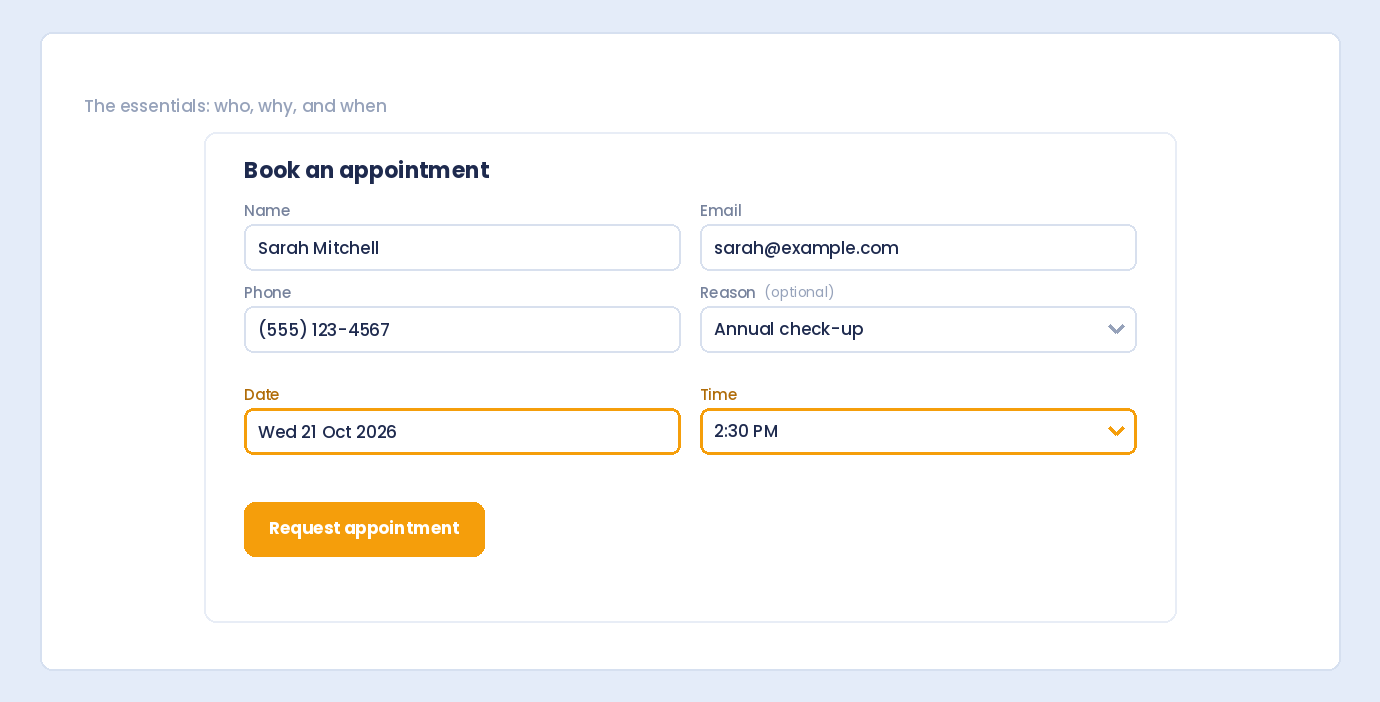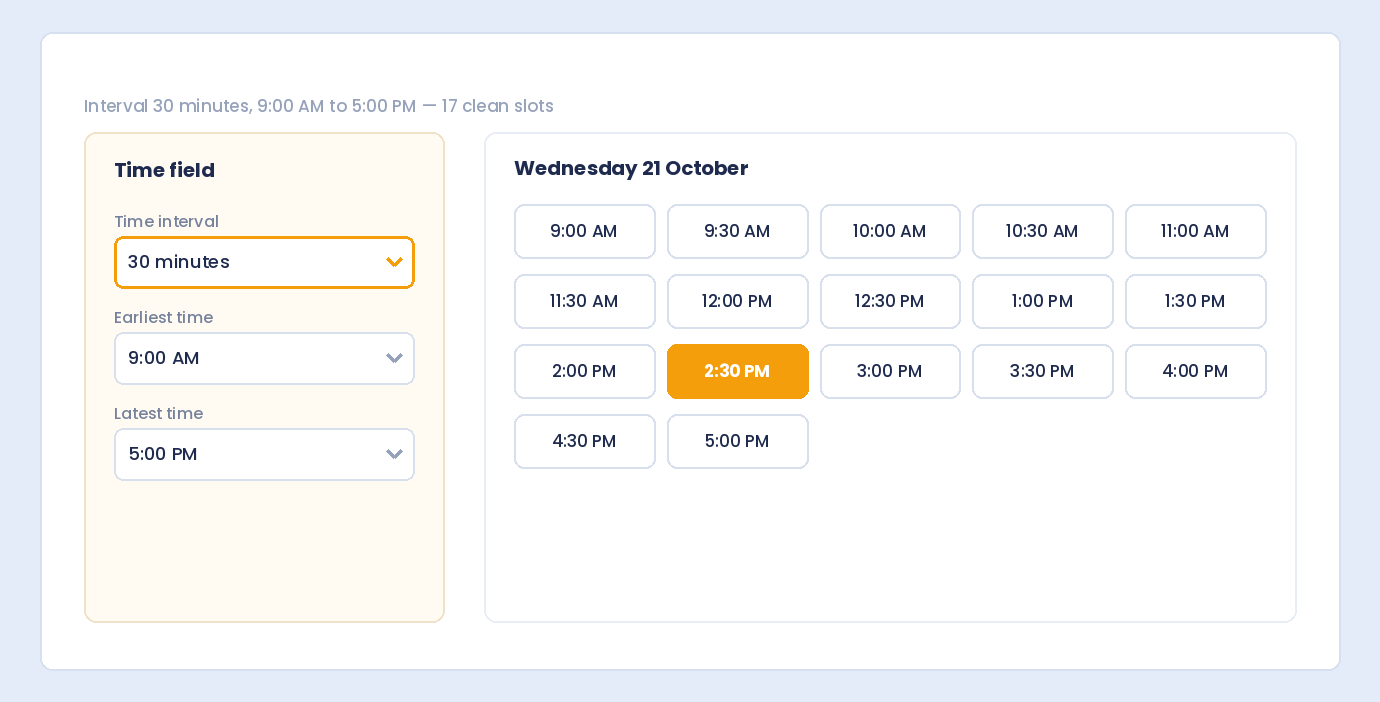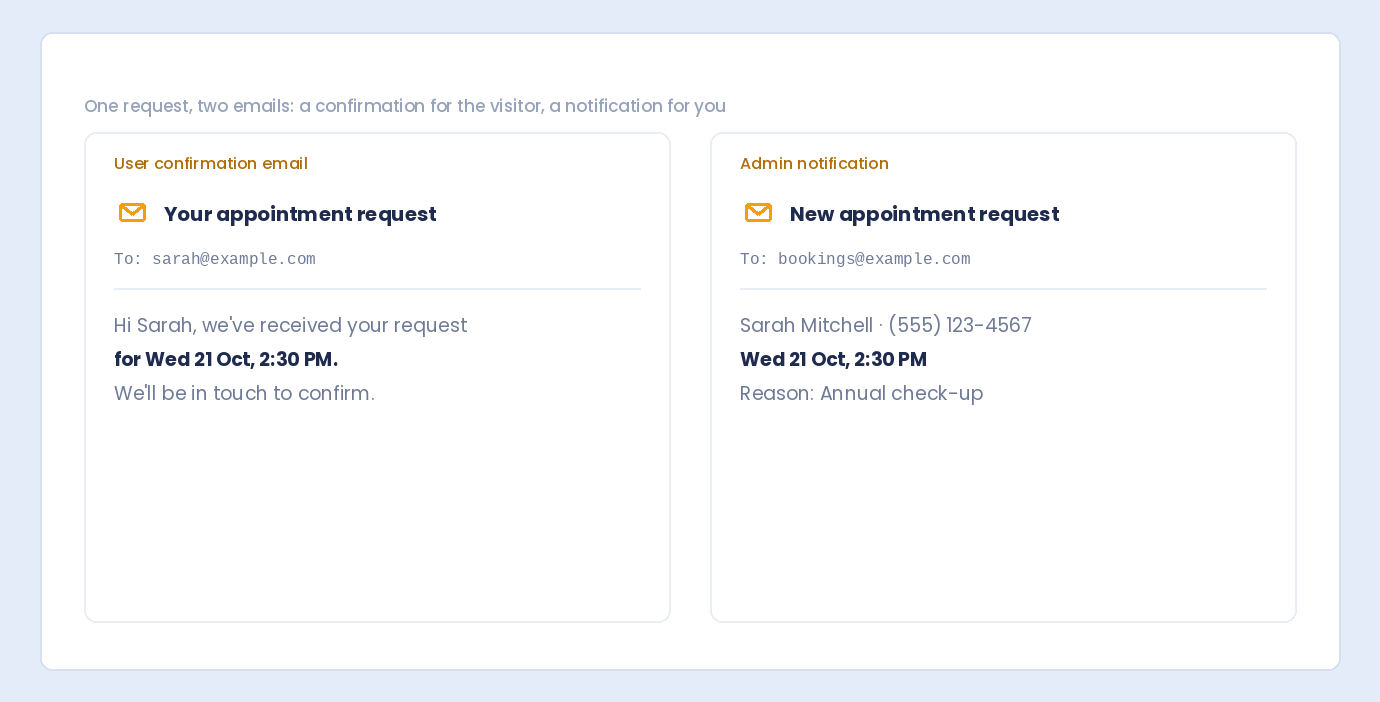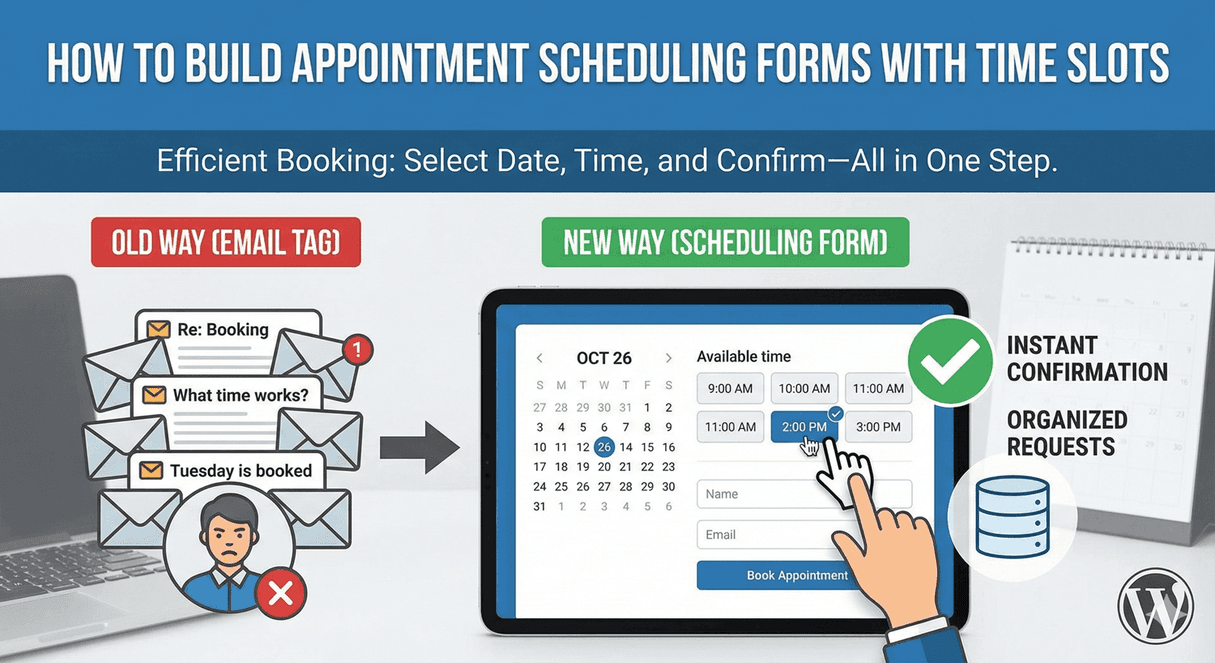
Appointment scheduling forms need two things visitors understand instantly: which day they can book, and which time slots are available. A free-text “preferred time” field invites vague answers like “afternoon sometime.” Structured date and time fields give you clean, actionable booking requests you can process without back-and-forth emails. Auto Form Builder lets you build appointment forms with a Date field for the booking day and a Time field with a custom dropdown of selectable slots — controlled by interval steps and earliest/latest time limits that act as your business hours. Combine them with name, email, and phone fields for a complete scheduling form, no custom code required. Last updated: Last update 9 August A professional appointment form collects structured booking data: Auto Form Builder handles the date and time collection natively. Submissions arrive in your inbox with the exact date and time the visitor selected — ready for you to confirm, add to your calendar, or follow up by email. Important: Auto Form Builder does not include real-time calendar availability, double-booking prevention, or automatic calendar sync. It collects appointment requests through validated date and time fields — you manage confirmation and scheduling on your end. The Time field uses a custom dropdown picker — not a plain text box. Visitors click to open a scrollable list of available times generated from your settings: For a typical business-hours appointment form, set Earliest Time to Go to Auto Form Builder → All Forms and click Create New Form, or open an existing form to add scheduling fields. Drag these fields onto the canvas: Add a Dropdown field labeled Appointment Type or Service with options like Consultation, Follow-up, New Client, etc. Use conditional logic later if different services need different time windows. Drag a Date field (Basic category) and configure under Date Field Options: Drag a Time field (Basic category) and configure under Time Field Options: Add a Text Area labeled Additional Notes for special requests. Save the form, preview the date picker and time slot dropdown, submit a test entry, and publish with the shortcode or embed code. Control which days visitors can book: Date restrictions are validated on the frontend and again server-side on every submission. Set Earliest Time Allowed and Latest Time Allowed to define your daily booking window. Only slots within that range appear in the dropdown. Leave empty for no restriction (full 24-hour range). Choose 12-hour (2:30 PM) or 24-hour (14:30) display. The submitted value is stored in 24-hour format regardless of display preference. Pre-select the current time, a specific time, or leave blank so visitors must choose a slot. Use conditional logic to tailor scheduling fields based on answers: Conditional logic evaluates in real time as visitors complete the form. When someone submits an appointment request: Enable confirmation emails in form settings and select the Email field as the recipient. The submitted date and time values appear in both admin and confirmation messages using the field’s configured formats. Be clear about scope when building scheduling forms: For many small businesses, a structured request form with validated date and time slots is exactly what’s needed — you confirm availability by email or phone, then add the appointment to your calendar. Forms embedded on non-WordPress sites use the same date picker, time slot dropdown, and validation behavior. Whether placed via shortcode or embed code, appointment scheduling fields work identically everywhere. Date fields, time slot dropdowns, business-hour limits, and interval steps are included in the free plugin — the same plugin that gives you submission management, email notifications, conditional logic, and spam protection at no cost. Install it from the official WordPress.org directory: https://wordpress.org/plugins/auto-form-builder/ Last updated: Last update 9 August Auto Form Builder lets you create multi-step forms, calculators, and lead capture forms in WordPress, then embed them on any site with a single line of code. Add a Time field in Auto Form Builder, set Time Intervals (e.g., Every 30 minutes), and configure Earliest Time Allowed and Latest Time Allowed for your business hours. Visitors pick from a dropdown of generated slots. Yes. Set Earliest Time Allowed and Latest Time Allowed under Time Field Options. Only times within that window appear as selectable slots. Yes. Enable No Weekend Selection on the Date field. Saturday and Sunday dates are blocked, and accidental weekend selections move to the next Monday. Yes. Enable Block Past Dates on the Date field. Past dates cannot be selected and are validated on submission. Every minute, 5 minutes, 10 minutes, 15 minutes, 30 minutes, or hourly — configured under Time Intervals in Time Field Options. No. The plugin collects appointment requests with validated date and time fields. You confirm bookings and add them to your calendar manually or through separate integrations. No. Time slots are not checked against existing submissions in real time. You review requests in the submission inbox and confirm availability before finalizing appointments. Yes. Date and Time fields with intervals, business-hour limits, and validation are included in the free Auto Form Builder plugin on WordPress.org.How to Build Appointment Scheduling Forms with Time Slots
What Makes a Good Appointment Scheduling Form?
How Time Slots Work in Auto Form Builder
09:00 for a 9 AM opening)17:00 for a 5 PM closing)09:00, Latest Time to 17:00, and Time Intervals to Every 30 minutes. Visitors see slots like 9:00 AM, 9:30 AM, 10:00 AM through 5:00 PM — no typing, no invalid times.How to Build an Appointment Scheduling Form
Step 1: Create a New Form
Step 2: Add Contact Fields
Step 3: Add a Service or Appointment Type (Optional)
Step 4: Add the Appointment Date Field
Step 5: Add the Time Slot Field
09:00)17:00)Step 6: Add Notes and Save
Date Field Settings for Scheduling
Time Field Settings for Time Slots
Time Intervals (Slot Spacing)
Business Hours (Earliest and Latest Time)
Time Format
Starting Time Selection
Example Appointment Form Configurations
General Consultation (Weekdays, 30-Min Slots)
Medical Clinic (15-Min Slots, Business Hours)
Salon or Spa (Hourly Slots, Limited Days)
Same-Day Emergency Callback
Combine Date and Time with Conditional Logic
Notifications and Submission Management
What Auto Form Builder Does Not Include
Appointment Forms on Embedded Sites
Download Auto Form Builder — Free Scheduling Fields
Build forms that embed anywhere — free
Frequently Asked Questions
How do I add time slots to a WordPress appointment form?
Can I restrict appointment times to business hours only?
Can I block weekend appointments?
Can I prevent booking dates in the past?
What time slot intervals are available?
Does Auto Form Builder sync with Google Calendar?
Does it prevent double-booking the same time slot?
Are date and time scheduling fields free?
Table of Contents
Table of Contents
Learn how to bulk delete form submissions in WordPress. Remove multiple entries at once to clean up spam, test data, and old submissions efficiently.
Master WordPress form submission management. Learn to view, filter, search, star, export, and organize form entries like a pro with this complete guide.
Learn how to search and find form submissions in WordPress. Filter by date, form, status, and search across all submission data.
Comparing Auto Form Builder and Contact Form 7 for WordPress. See which form plugin offers better ease of use, features, and value for your website.
Learn how to view, organize, search, filter, and export your WordPress form submissions. Complete guide to submission management.
Learn why storing form data on your own server helps with GDPR compliance. Choose form plugins that keep your user data local and under your control.
Learn how to filter WordPress form submissions by date. Find entries from specific time periods quickly using date range filters.
Learn how to bulk edit, delete, and manage form submissions in WordPress. Save time with mass actions on multiple entries at once.
Learn how to restrict date fields to future dates only for event registration forms. Block past dates and set booking windows in WordPress.
Learn how to create quantity fields in WordPress forms. Collect numbers for guests, items, tickets, and more with proper validation and limits.
Learn how to star and flag important form submissions in WordPress. Prioritize leads, mark urgent requests, and organize your form entries effectively.
Learn how to set up email notifications for your WordPress forms so you never miss a submission. Step-by-step guide with Auto Form Builder.