How to Add a Newsletter Signup Form to Your WordPress Site
Your email list is one of your most valuable marketing assets. Unlike social media followers, you own your email list—and it’s the most direct way to reach your audience.
But first, you need to collect those email addresses. A newsletter signup form makes it easy for visitors to subscribe.
In this guide, you’ll learn how to create effective newsletter signup forms for your WordPress site.
Why Newsletter Signup Forms Matter
Direct Communication
- Email reaches subscribers directly—no algorithm filtering
- Higher engagement than social media
- You control the relationship
Higher Conversion Rates
- Email converts better than social or search traffic
- Subscribers are already interested in your content
- Repeat exposure builds trust
Ownership
- Social platforms change algorithms constantly
- Your email list is yours forever
- Portable—move between email providers
Revenue Potential
- Promote products and services directly
- Affiliate marketing opportunities
- Sponsored content possibilities
Newsletter Form Basics
Essential Fields
The minimum for a newsletter form:
- Email address (required) – The only truly necessary field
Optional Fields
Consider adding:
- First name – Personalize emails (“Hi John!”)
- Last name – Fuller personalization
- Interests – Segment your list
The Golden Rule
Fewer fields = more signups. Every additional field reduces conversion rates. Only ask for what you’ll actually use.
Creating Your Newsletter Form
Here’s how to build a newsletter signup form with Auto Form Builder:
Step 1: Install Auto Form Builder
- Go to Plugins → Add New
- Search for “AFB” (the short name for Auto Form Builder)
- Find “AFB – Auto Form Builder – Drag & Drop Form Creator“
- Click Install Now, then Activate

Install Auto Form Builder
Step 2: Create a New Form
- Go to Auto Form Builder → Add New
- Select the Newsletter Signup template
- Or start with Blank to build from scratch

Create a New Form
Step 3: Add Email Field
- Drag the Email field onto your form
- Configure settings:
- Label: “Email Address” or “Your Email”
- Placeholder: “[email protected]”
- Required: Yes
Step 4: Add Name Field (Optional)
For personalized emails:
- Drag a Text field or Name field onto your form
- Configure:
- Label: “First Name” or “Your Name”
- Required: No (keep signup easy)

Add Email Field
Step 5: Configure Form Settings
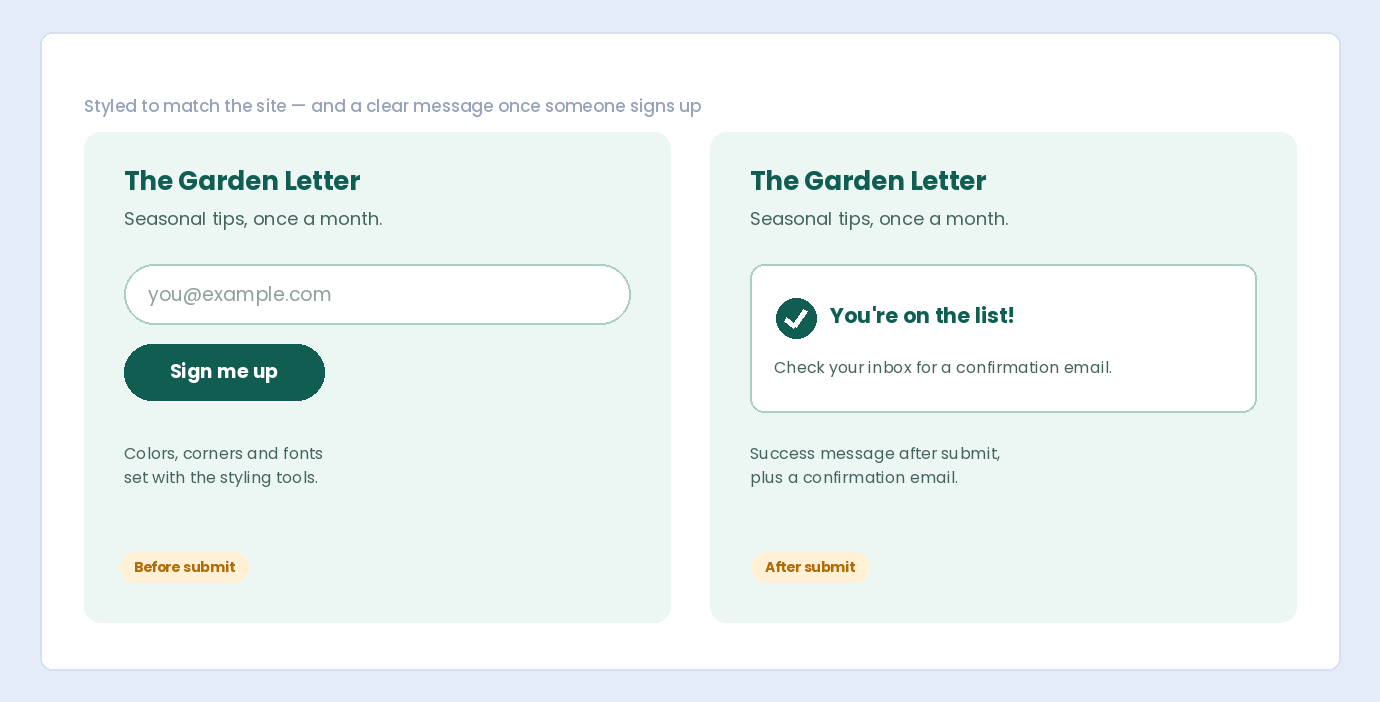
Success Message
Set a clear confirmation:
“Thanks for subscribing! Check your inbox for a confirmation email.”
Submit Button
Use action-oriented text:
- “Subscribe”
- “Join the List”
- “Get Updates”
- “Sign Me Up”
- “Yes, I Want In!”
Email Notifications
Enable notifications to receive alerts when someone subscribes (optional—you may prefer to manage in your email marketing tool).

Configure Form Settings
Step 6: Style Your Form
Make it visually appealing:
- Match your site’s colors
- Make the button stand out
- Keep it clean and simple
- Ensure mobile-friendly design

Style Your Form
Step 7: Place the Form
Embed your form where visitors will see it:
- Copy the form shortcode
- Paste into a page, post, or widget area
Where to Place Newsletter Forms
High-Visibility Locations
Homepage
Above the fold or in a prominent section. First-time visitors should see it.
Blog Sidebar
Visible on every blog post. Readers engaged with content are likely to subscribe.
After Blog Posts
Place at the end of articles. Readers who finish are interested—capture them.
Header/Navigation Area
Persistent visibility across all pages. Usually a compact inline form.
Footer
Catches visitors before they leave. Good for site-wide presence.
Dedicated Landing Page
A page focused solely on newsletter signup. Link from social media, emails.
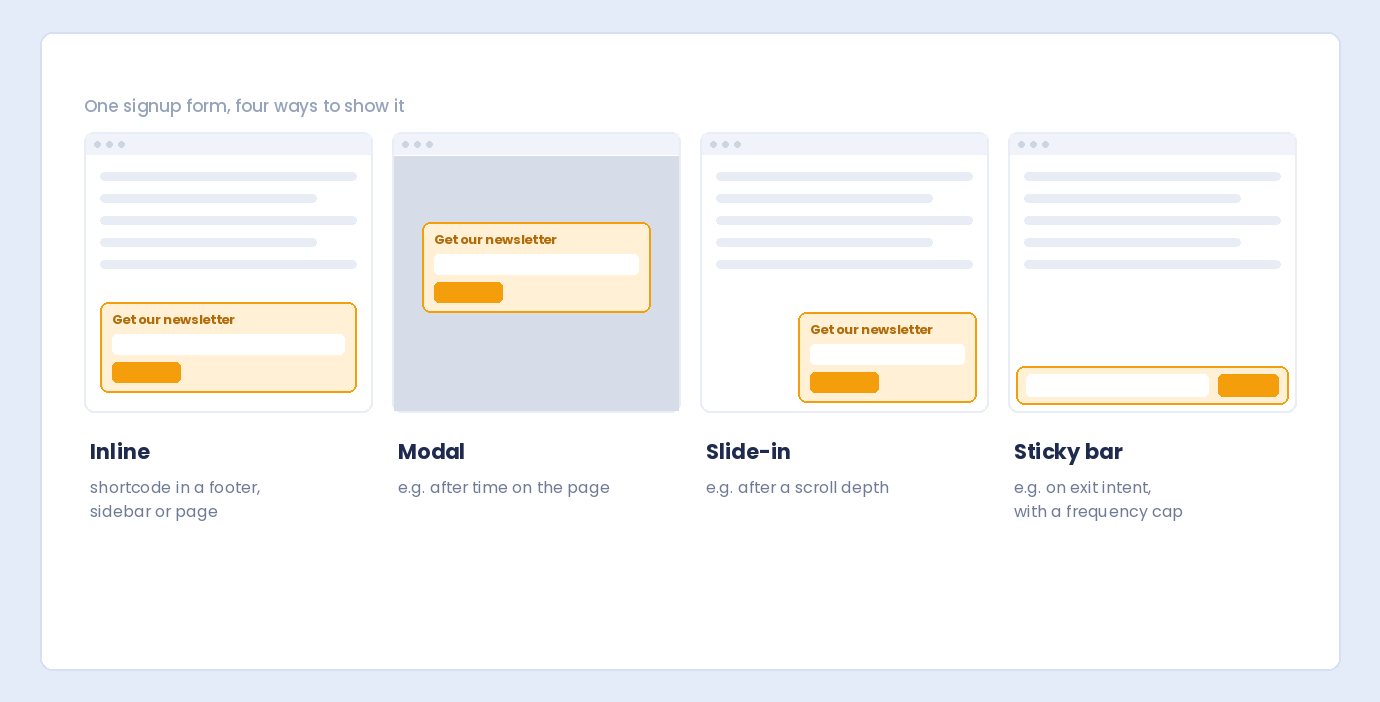
Strategic Placements
Exit-Intent Popups
Trigger when visitors are about to leave. Last chance to capture.
Scroll-Triggered Forms
Appear after reading a certain percentage. Engaged readers see it.
Within Content
Inline forms mid-article. Natural pause point for subscription offer.
Resource Pages
“Get our free guide” with email signup. Value exchange.
Newsletter Form Best Practices
1. Keep It Short
One field (email) converts best. Add name only if you’ll use it for personalization.
| Fields | Typical Conversion Rate |
|---|---|
| Email only | Highest |
| Email + First Name | Slightly lower |
| Email + Name + Other | Significantly lower |
2. Offer Value
Why should someone subscribe? Tell them:
- “Get weekly tips on [topic]”
- “Be the first to know about new products”
- “Exclusive discounts for subscribers”
- “Free [resource] when you subscribe”
3. Use Compelling Headlines
Above your form, use headlines that speak to benefits:
- ✅ “Get Marketing Tips That Actually Work”
- ✅ “Join 10,000+ Subscribers Getting Weekly Insights”
- ❌ “Subscribe to Our Newsletter” (boring)
- ❌ “Email List” (not compelling)
4. Make the Button Stand Out
- Contrasting color from background
- Large enough to notice
- Action-oriented text
- Consider button hover effects
5. Include Social Proof
Build trust:
- “Join 5,000+ subscribers”
- “Trusted by marketers at Company X, Y, Z”
- Testimonials from subscribers
6. Set Expectations
Tell subscribers what they’ll get:
- Frequency: “Weekly updates” or “Monthly digest”
- Content type: “Tips, tutorials, and exclusive offers”
- Privacy: “No spam, unsubscribe anytime”
7. Ensure Mobile-Friendliness
- Form should be easy to use on phones
- Input fields large enough to tap
- Button easy to press
- Text readable without zooming
Lead Magnets: Boosting Signups
A lead magnet is something valuable you offer in exchange for an email:
Common Lead Magnets
- Ebooks/Guides: “Download our free guide to…”
- Checklists: “Get our 10-point checklist”
- Templates: “Free email template pack”
- Discounts: “Get 10% off your first order”
- Free courses: “5-day email course on…”
- Exclusive content: “Members-only articles”
- Tools/Calculators: “Free ROI calculator”
Lead Magnet Form Setup
- Create your newsletter form
- Add compelling headline about the lead magnet
- Success message includes download link or delivery promise
- Send lead magnet via email notification or redirect to download page
Connecting to Email Marketing Tools
Form submissions need to reach your email marketing platform:
Manual Method
- Receive email notification for each signup
- Manually add to your email list
- Or export CSV periodically and import
Works for low volume but tedious at scale.
Integration Options
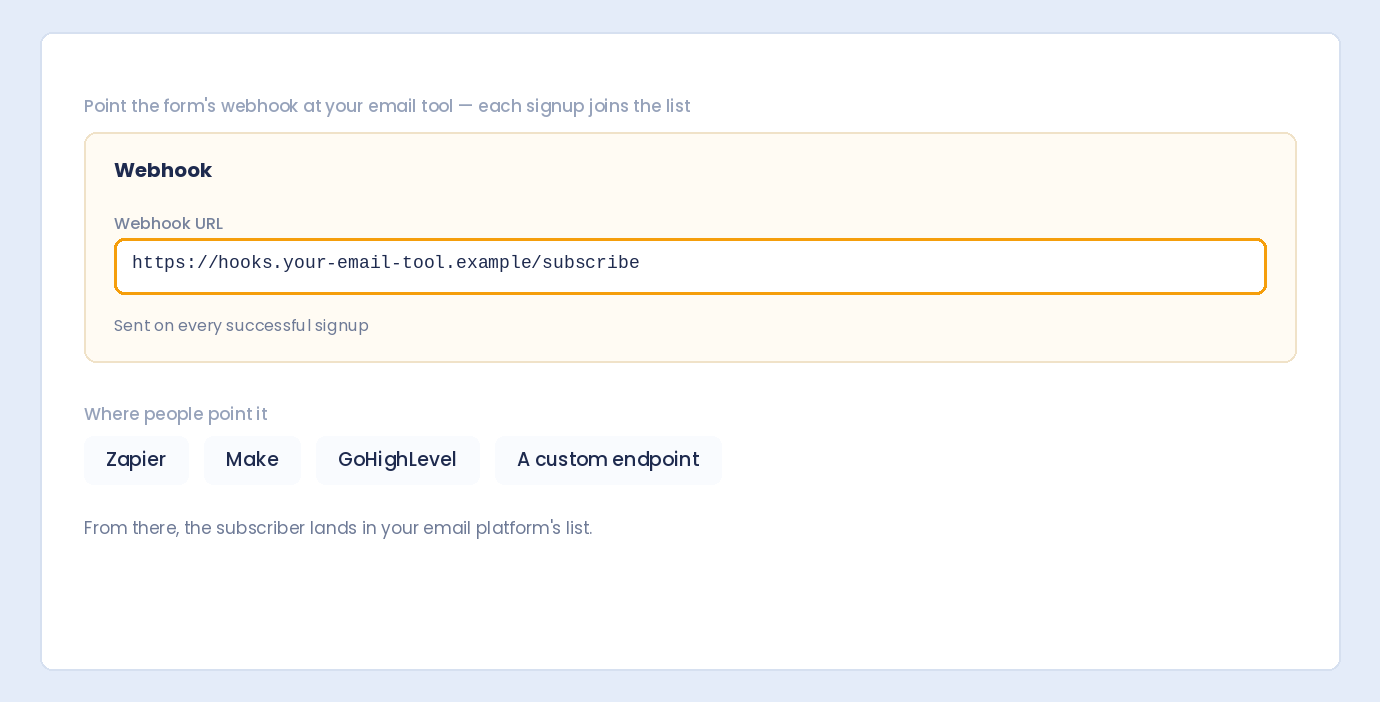
For automated subscriber management, consider:
- Zapier: Connect forms to Mailchimp, ConvertKit, etc.
- Direct integrations: Some form plugins offer native connections
- Google Sheets: Export to Sheets, then connect to email tool
- Webhooks: Send data to your email platform’s API
Popular Email Platforms
- Mailchimp
- ConvertKit
- Constant Contact
- ActiveCampaign
- Sendinblue
- MailerLite
GDPR and Privacy Compliance
If you have EU visitors, comply with GDPR:
Consent Checkbox
Add a required checkbox:
☐ I agree to receive email updates. View our Privacy Policy.
Clear Privacy Information
- Link to your privacy policy
- Explain how you’ll use their email
- Mention they can unsubscribe anytime
Double Opt-In
Consider requiring email confirmation:
- User submits form
- Confirmation email sent
- User clicks link to confirm
- Only then added to active list
This is handled by your email marketing platform, not the form itself.
Measuring Newsletter Form Success
Key Metrics
Conversion Rate
Signups ÷ Form Views × 100
- Good: 2-5%
- Excellent: 5-10%+
Submission Count
Raw number of signups over time.
List Growth Rate
New subscribers per week/month.
Improving Performance
A/B Test Elements
- Headlines
- Button text
- Form placement
- Number of fields
- Colors/design
Analyze Drop-Off
- Do people start but not finish?
- Is a field causing friction?
- Is the form too long?
Common Newsletter Form Mistakes
❌ Too Many Fields
Every field reduces signups. Email-only is often best.
❌ No Value Proposition
“Subscribe to our newsletter” doesn’t tell visitors why they should.
❌ Hidden Form
If visitors can’t find it, they can’t sign up. Make it visible.
❌ Generic Button Text
“Submit” is boring. Use action words that excite.
❌ No Mobile Optimization
Half your visitors are on mobile. Test on phones.
❌ Ignoring GDPR
EU visitors need proper consent. Add checkbox and privacy info.
❌ No Thank You Message
Confirm the signup worked. Set expectations for what comes next.
Newsletter Form Examples
Minimalist (Email Only)
📧 Get Weekly Tips [[email protected] ] [Subscribe] No spam. Unsubscribe anytime.
With Name
Join 5,000+ Subscribers [First Name ] [Email Address ] [ Get Free Updates ] Weekly insights on marketing. No spam ever.
Lead Magnet Style
🎁 FREE: The Ultimate SEO Checklist Get our 50-point checklist that helped 1,000+ sites improve their rankings. [Email Address ] [ Download Free Checklist ] Plus weekly SEO tips. Unsubscribe anytime.
Inline/Compact
Newsletter: [[email protected]] [Join]
Frequently Asked Questions
Should I require name or just email?
Email-only converts best. Add name only if you’ll use it for personalization. Make it optional if included.
How often should I email subscribers?
Set expectations upfront. Weekly is common. Monthly works for some niches. Don’t disappear—consistent contact keeps engagement high.
Where’s the best place for a newsletter form?
Multiple places: sidebar, after posts, footer. Test different placements to see what works for your audience.
Do I need double opt-in?
It’s recommended for GDPR compliance and list quality. Your email marketing tool handles this.
How do I get submissions into Mailchimp/ConvertKit?
Export CSV and import, use Zapier integration, or check if direct integration is available.
Summary
Creating a newsletter signup form:
- Keep it simple – Email field (required), name (optional)
- Offer value – Tell visitors why they should subscribe
- Place strategically – Sidebar, after posts, footer, homepage
- Use compelling copy – Strong headline, action button text
- Stay compliant – GDPR consent if needed
- Connect to email tool – Manual export or integration
- Test and improve – Measure conversion, A/B test elements
Conclusion
A newsletter signup form is your gateway to building an email list—one of the most valuable assets for any website. Keep it simple, offer clear value, and place it where visitors will see it.
Auto Form Builder makes creating newsletter forms easy. Use the Newsletter Signup template or build your own with just an email field. Style it to match your brand, embed it anywhere, and start growing your list.
Ready to build your email list? Download Auto Form Builder and create your newsletter signup form today.