
New form submissions pile up fast. Without tracking which ones you’ve reviewed, you’ll waste time re-reading entries or—worse—miss important ones entirely. Read/unread status solves this: new entries arrive as “unread,” and you mark them “read” once reviewed. Simple, effective inbox management for your forms. In this guide, you’ll learn how to use read/unread status to track and manage your WordPress form submissions. In the submissions list: Look for visual indicators: Result: Focus on entries that need your attention. Automatic marking: Without opening submission: For multiple entries: Use case: Daily processing—start with unread, work through list. Use case: Find a previously reviewed submission. Use case: Overview of all submissions. See unread entries for one form: See today’s unread entries: Find specific unread entry: Treat unread submissions like emails: Important to understand: Read/unread and stars serve different purposes: Don’t let unread pile up: Only mark as read when you’ve actually: Return to unread if: Power users combine: When sharing responsibilities: Situation: Back from vacation, many unread submissions. Approach: Situation: Need to quickly identify urgent submissions. Approach: Situation: Need team member to handle certain submissions. Approach: Situation: Just want to see what came in, not process now. Approach: Causes: Solutions: Check: Causes: Solutions: Usually no—just viewing the list doesn’t mark as read. You typically need to click into the detail view. Check your specific setup. Standard implementations use shared status. For personal tracking, consider using stars or external notes. Unread = haven’t reviewed yet. Starred = flagged as important. An entry can be read but still starred (reviewed but needs follow-up). Use bulk actions: select all on page, choose “Mark as Read,” apply. Useful for clearing test entries or catching up. Many implementations show unread count in menu or on submissions page header. Provides quick visibility of new entries. Managing read/unread status: Read/unread status is simple but powerful. It transforms form submission management from chaotic to organized, ensuring you never miss new entries and always know what needs attention. Combined with filtering and stars, it creates an efficient workflow for any volume of submissions. Auto Form Builder includes read/unread status tracking with visual indicators, filtering, and bulk actions. Stay on top of your form submissions with clear visibility into what’s new and what’s been processed. Ready for organized submission management? Download Auto Form Builder and never lose track of a form entry again.How to Mark Form Submissions as Read or Unread
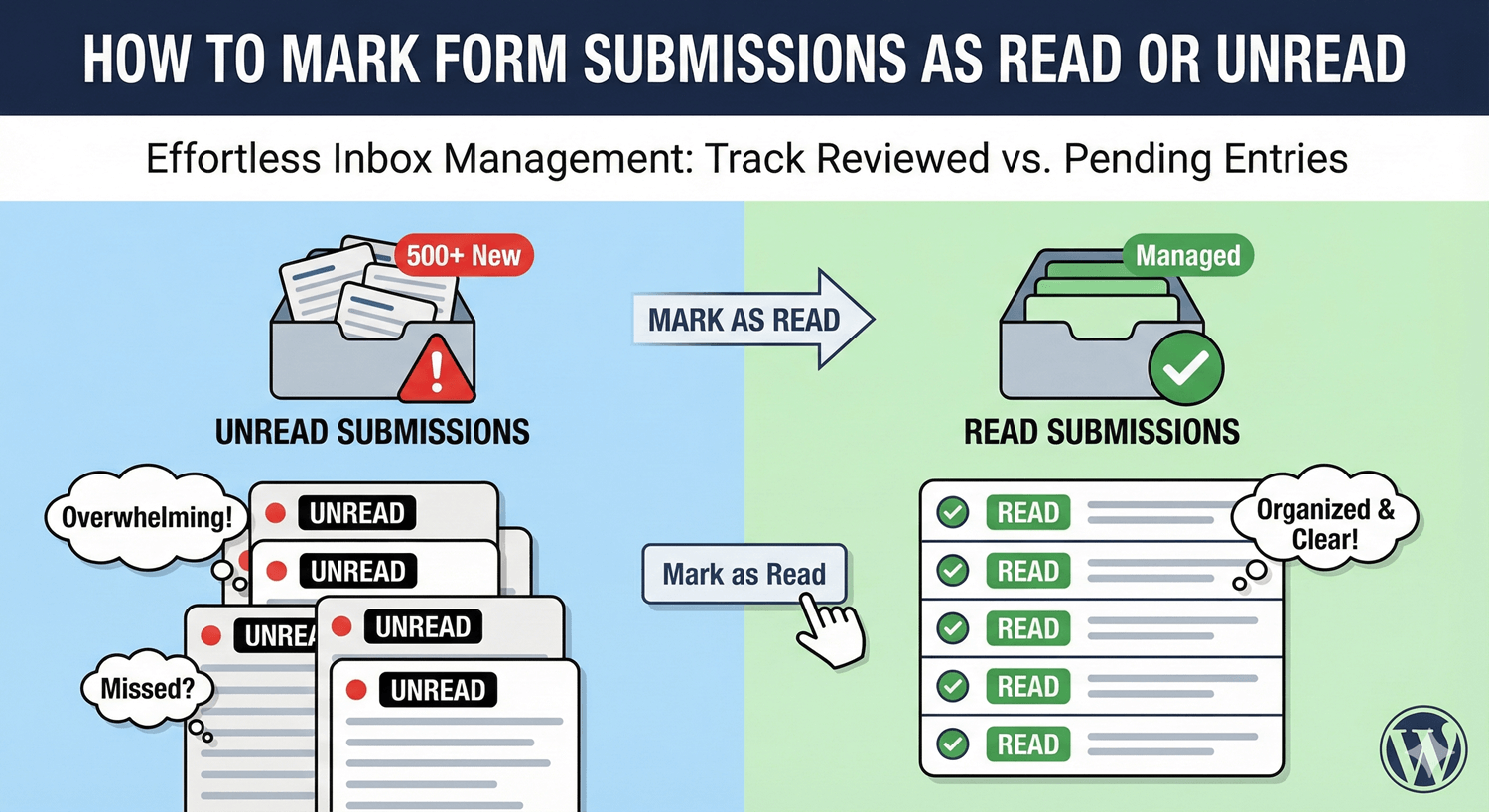
Why Track Read/Unread Status?
The Problem Without Status Tracking
Benefits of Read/Unread Status
How Read/Unread Status Works
Default Behavior
Visual Indicators
Status Persistence
Viewing Unread Submissions
Step 1: Access Submissions
Step 2: Identify Unread Entries
Step 3: Filter by Unread Only
Marking Submissions as Read
Method 1: View the Submission
Method 2: Manual Toggle (Individual)
Method 3: Bulk Mark as Read
Marking Submissions as Unread
Why Mark as Unread?
Method 1: Manual Toggle
Method 2: Bulk Mark as Unread
Filtering by Read Status
View Only Unread
View Only Read
View All
Combining Status with Other Filters
Unread + Specific Form
Unread + Date Range
Unread + Search
Daily Workflow with Read/Unread
Recommended Daily Process
Morning Check
Process Each Entry
End of Day
The “Inbox Zero” Approach
Team Workflow Considerations
Shared Read Status
Team Coordination Options
Assign by Form
Time-Based
Use Stars for Assignment
Using Read Status with Stars
Complementary Features
Read/Unread
Stars
Have you seen it?
Is it important?
Processing workflow
Priority flagging
Daily inbox management
Special attention items
Combined Workflow
Best Practices
1. Process Regularly
2. Mark Read Intentionally
3. Use “Mark Unread” Strategically
4. Combine with Filters
5. Team Communication
Common Scenarios
Scenario 1: Vacation Catch-Up
Scenario 2: High-Priority Detection
Scenario 3: Delegation
Scenario 4: Quick Scan
Troubleshooting
Entry Not Marking as Read
Can’t Find Unread Filter
All Entries Showing as Read
Frequently Asked Questions
Does viewing the list mark entries as read?
Can I have personal read status separate from team?
What’s the difference between unread and starred?
Can I automatically mark all as read?
Is there an unread count somewhere?
Summary
Conclusion


Learn how to bulk delete form submissions in WordPress. Remove multiple entries at once to clean up spam, test data, and old submissions efficiently.

Master WordPress form submission management. Learn to view, filter, search, star, export, and organize form entries like a pro with this complete guide.

Learn how to search and find form submissions in WordPress. Filter by date, form, status, and search across all submission data.
Comparing Auto Form Builder and Contact Form 7 for WordPress. See which form plugin offers better ease of use, features, and value for your website.

Learn how to view, organize, search, filter, and export your WordPress form submissions. Complete guide to submission management.

Learn why storing form data on your own server helps with GDPR compliance. Choose form plugins that keep your user data local and under your control.

Learn how to filter WordPress form submissions by date. Find entries from specific time periods quickly using date range filters.

Learn how to bulk edit, delete, and manage form submissions in WordPress. Save time with mass actions on multiple entries at once.

Learn how to restrict date fields to future dates only for event registration forms. Block past dates and set booking windows in WordPress.

Learn how to create quantity fields in WordPress forms. Collect numbers for guests, items, tickets, and more with proper validation and limits.

Learn how to star and flag important form submissions in WordPress. Prioritize leads, mark urgent requests, and organize your form entries effectively.

Learn how to set up email notifications for your WordPress forms so you never miss a submission. Step-by-step guide with Auto Form Builder.
