How to Create an International Address Form in WordPress

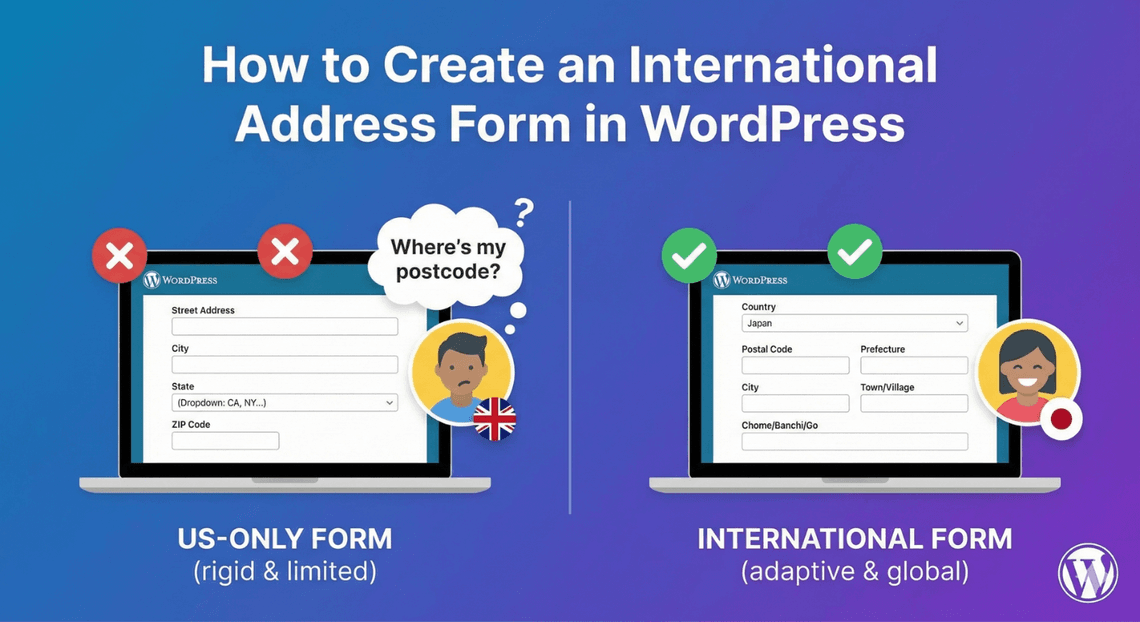
Addresses look different around the world. US addresses have states and ZIP codes. UK addresses have postcodes and counties. Japanese addresses start with the largest unit first. If your forms serve a global audience, a US-only address format won’t work. You need an international address form that adapts to how addresses work in different countries.

In this guide, you’ll learn how to create address forms that work for visitors from any country.

Why International Address Forms Matter

The Problem with Country-Specific Forms

A US-only address form asks for:

  • Street Address
  • City
  • State (dropdown with 50 states)
  • ZIP Code (5-digit validation)

This breaks for international users:

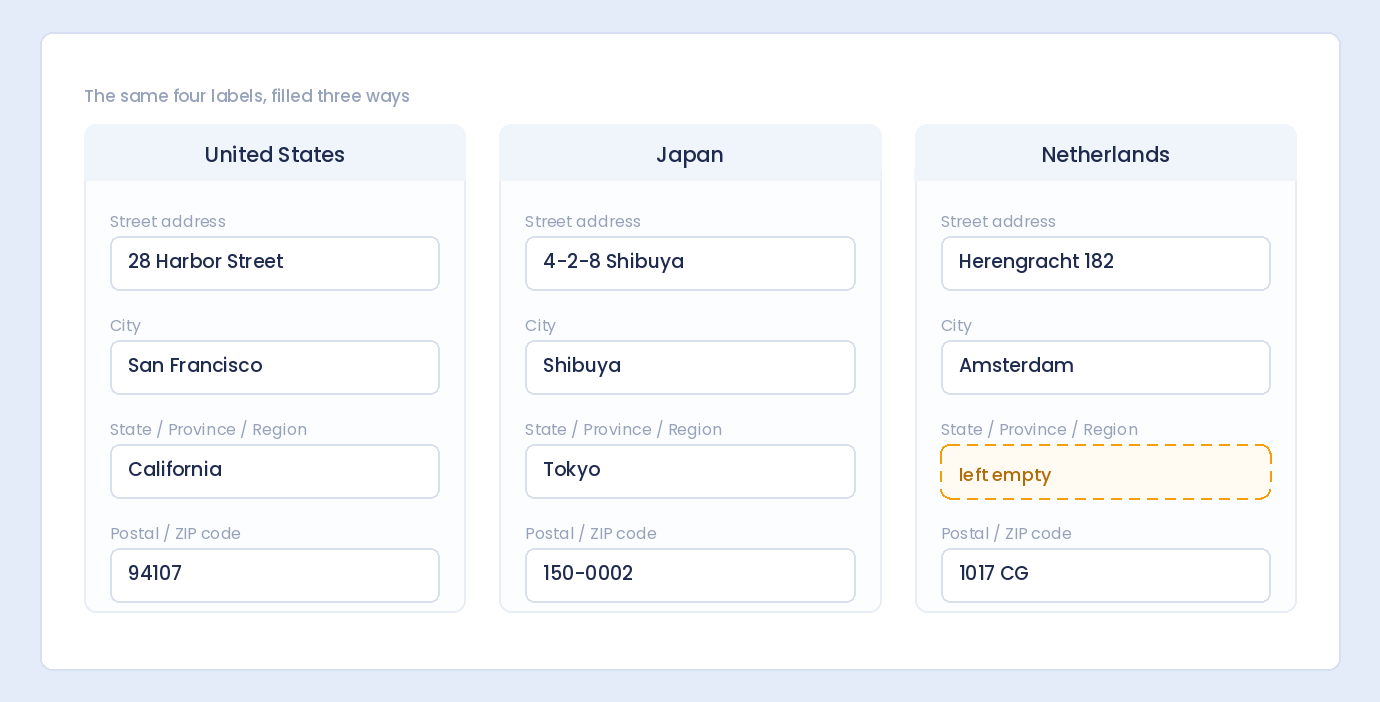
  • UK: No states, has postcodes (different format)
  • Canada: Provinces, not states; alphanumeric postal codes
  • Germany: No states required; different postal format
  • Japan: Prefecture, city, then street (reverse order)

International Form Benefits

  • Works for any country
  • Flexible labels and validation
  • Professional global presence
  • Higher completion rates worldwide
  • Accurate international data

Address Components Worldwide

Universal Components

Present in most countries:

  • Street Address: House/building number, street name
  • City: Town, city, or locality
  • Postal Code: ZIP, postcode, PIN (format varies)
  • Country: Nation

Variable Components

Differ by country:

  • Region: State, province, prefecture, county
  • Address Line 2: Apartment, suite, unit, floor
  • Organization: Company or building name

Regional Terminology

Country “State” Term “Postal Code” Term
USA State ZIP Code
Canada Province/Territory Postal Code
UK County (optional) Postcode
Australia State/Territory Postcode
Germany Bundesland (optional) Postleitzahl (PLZ)
Japan Prefecture Postal Code
India State PIN Code
France Region (optional) Code Postal

Creating an International Address Form

Step 1: Add Address Field

  1. Open your form in AFB
  2. Drag the Address field to your form
  3. Click to configure settings

Step 2: Select International Preset

  1. Find the Address Preset option
  2. Select International
  3. This configures flexible components for global use


Address Type

Address Type

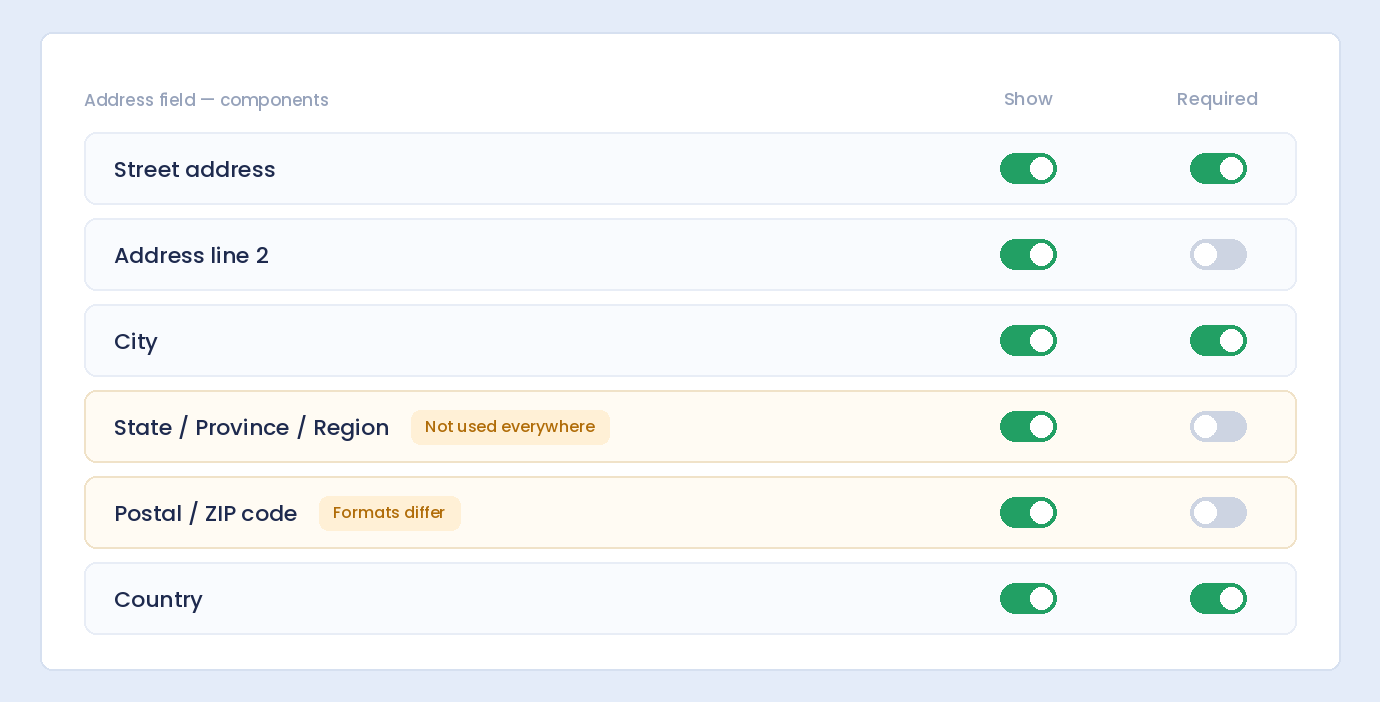
Step 3: Enable Required Components

For international addresses, enable:

  • ☑ Address Line 1 (required)
  • ☑ Address Line 2 (optional)
  • ☑ City (required)
  • ☑ State/Province/Region (optional or required)
  • ☑ Postal Code (required)
  • ☑ Country (required)

Step 4: Configure Labels

Use generic international labels:

  • “Street Address” (not “Address”)
  • “Apartment, suite, etc.” (not “Apt #”)
  • “City” (universal)
  • “State / Province / Region” (covers all)
  • “Postal / ZIP Code” (covers both terms)
  • “Country” (required for international)

Step 5: Set Up Country Dropdown

  • Include all countries (or relevant subset)
  • Consider default based on audience
  • Alphabetical order for easy finding
  • Consider “United States” and “United Kingdom” near top if most users

International Address Configuration

Recommended Setup

Address Line 1

  • Label: “Street Address”
  • Placeholder: “123 Main Street”
  • Required: Yes

Address Line 2

  • Label: “Apartment, suite, unit, etc.”
  • Placeholder: “Apt 4B”
  • Required: No

City

  • Label: “City”
  • Placeholder: “New York”
  • Required: Yes

State/Province/Region

  • Label: “State / Province / Region”
  • Type: Text field (not dropdown)
  • Required: Depends on use case

Postal Code

  • Label: “Postal / ZIP Code”
  • Placeholder: “10001”
  • Required: Yes
  • Validation: Flexible (no strict format)

Country

  • Label: “Country”
  • Type: Dropdown
  • Required: Yes
  • Options: All countries or relevant subset

Handling Regional Variations

Text Field vs. Dropdown for Regions

Text Field (Recommended for International):

  • Works for any country
  • Users enter their region name
  • No preset list needed
  • Handles unknown regions

Dropdown (Country-Specific):

  • Only works if you know the country
  • Requires separate lists per country
  • More complex to implement
  • Better for single-country forms

Postal Code Validation

The Challenge

Postal codes vary wildly:

  • USA: 12345 or 12345-6789
  • Canada: A1A 1A1
  • UK: SW1A 1AA
  • Germany: 12345
  • Japan: 123-4567
  • India: 123456

International Approach

  • Don’t validate format strictly
  • Accept alphanumeric input
  • Allow spaces and hyphens
  • Set reasonable length (3-10 characters)

Basic Validation

  • Required: Yes (most addresses need it)
  • Min length: 3 characters
  • Max length: 10-12 characters
  • Pattern: Alphanumeric + spaces/hyphens

Country Dropdown Best Practices

Full Country List

Include all ~195 countries for true international forms.

Prioritized List

Put most common countries at top:

United States
United Kingdom
Canada
Australia
---
Afghanistan
Albania
Algeria
...

Regional Subset

For region-specific businesses:

  • EU countries only
  • North America only
  • Asia-Pacific only

Shipping Restrictions

If you can’t ship everywhere:

  • Only list countries you serve
  • Or note “We ship to these countries”

Layout for International Addresses

Recommended Layout

Street Address:     [________________________]
Apt, Suite, etc:    [________________________]
City:               [____________]
State/Province:     [____________]
Postal/ZIP Code:    [________]
Country:            [Select Country      ▼]

Compact Layout

Street Address:     [________________________]
City:               [________] State: [______] Postal: [____]
Country:            [Select Country      ▼]

Mobile Layout

Stack all fields vertically on small screens:

Street Address:     [________________________]
Apt, Suite, etc:    [________________________]
City:               [________________________]
State/Province:     [________________________]
Postal Code:        [________________________]
Country:            [________________________]

Use Cases

E-commerce Shipping

Requirements:

  • Complete address for delivery
  • Country for shipping rates
  • Accurate postal code for carriers

Configuration:

  • All components required
  • Country dropdown with shipping destinations
  • Clear “Shipping Address” label

Event Registration (International Conference)

Requirements:

  • Attendee location for planning
  • Mailing address for materials

Configuration:

  • Full international address
  • All countries included
  • Consider time zone field too

Business Inquiry (Global Company)

Requirements:

  • Know where lead is located
  • Route to regional sales team

Configuration:

  • City and Country minimum
  • Full address optional
  • Country required for routing

Membership Registration

Requirements:

  • Member directory listing
  • Physical mail (newsletters, cards)

Configuration:

  • Complete address
  • All components
  • International support

Common International Formats

United States

John Smith
123 Main Street
Apt 4B
New York, NY 10001
USA

United Kingdom

John Smith
123 High Street
Flat 4B
London
SW1A 1AA
United Kingdom

Canada

John Smith
123 Main Street
Suite 4B
Toronto, ON M5V 1A1
Canada

Germany

John Smith
Hauptstraße 123
Wohnung 4B
10115 Berlin
Germany

Japan

〒123-4567
Tokyo-to, Shibuya-ku
Shibuya 1-2-3
Building Name 4B
John Smith
Japan

Australia

John Smith
123 Main Street
Unit 4B
Sydney NSW 2000
Australia

Tips for Better UX

Country First (Optional Approach)

Some forms ask for country first, then adjust fields:

  • Fewer fields for simpler countries
  • Correct labels per country
  • Appropriate validation

Autocomplete Support

  • Enable browser autocomplete
  • Users can auto-fill from saved addresses
  • Faster completion for returning visitors

Clear Help Text

  • “Enter your full street address”
  • “Include apartment or unit number if applicable”
  • “Enter postal or ZIP code for your country”

Error Messages

  • “Please enter your street address”
  • “Please enter your city”
  • “Please select your country”
  • Avoid format-specific errors (“Invalid ZIP code”)

Frequently Asked Questions

Should I validate postal codes by country?

For simple forms, no—it adds complexity and can reject valid codes. For critical e-commerce, consider country-specific validation with fallback acceptance.

Is the region/state field necessary?

Depends on country. US and Canada need it. Many countries don’t. Make it available but consider optional for international forms.

Should country be at the top or bottom?

Traditionally at the bottom (like a mailing address). Some modern forms put it first to adjust subsequent fields. Both approaches work.

How do I handle addresses that don’t fit the format?

Include a “Additional address information” text area for edge cases. Some rural or unusual addresses need flexibility.

Summary

Creating international address forms:

  1. Use International preset – Flexible for all countries
  2. Enable all components – Line 1, Line 2, City, Region, Postal, Country
  3. Use generic labels – “State / Province / Region” not just “State”
  4. Text field for region – More flexible than dropdown
  5. Flexible postal validation – Don’t enforce specific format
  6. Complete country dropdown – All countries or your service area
  7. Required: Address, City, Country – Others optional
  8. Accept international characters – Unicode support

Conclusion

International address forms require flexibility over strict validation. Use generic component labels, accept various postal code formats, include all countries, and let users enter their region as text. The goal is capturing accurate addresses from anywhere in the world without frustrating users whose address doesn’t fit a US-centric format.

Auto Form Builder includes an International address preset with flexible components, country dropdown, and adaptable validation. Build address forms that work for your global audience.

Ready for global addresses? Download Auto Form Builder and create international address forms that work worldwide.

Leave a Reply

Your email address will not be published. Required fields are marked *