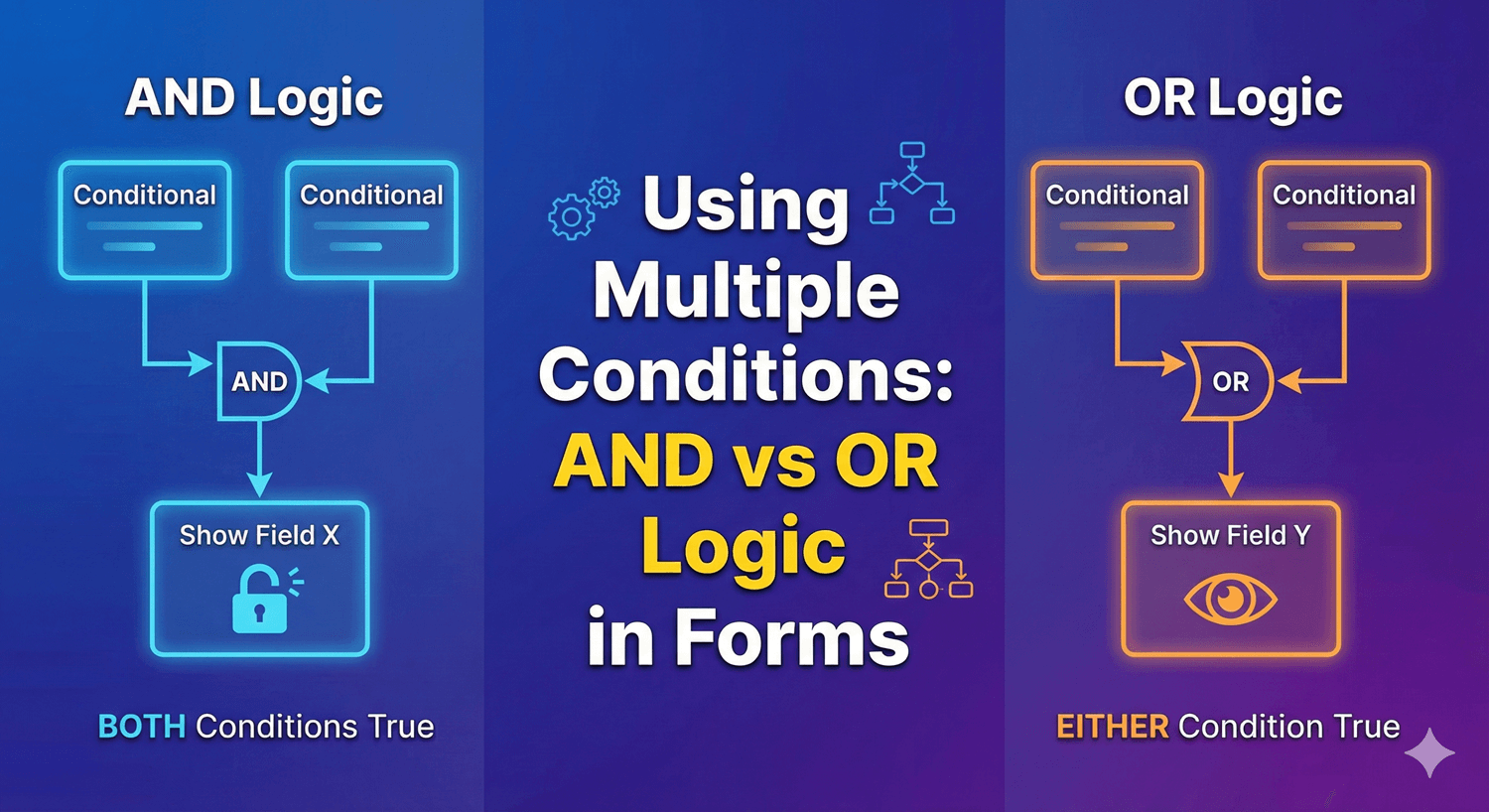
Single conditions are simple: IF this, THEN that. But real forms often need more complexity. What if a field should appear when BOTH conditions are true? Or when EITHER condition is true? That’s where AND and OR logic come in.

In this guide, you’ll learn how to combine multiple conditions using AND and OR logic to create sophisticated, intelligent forms.

Understanding AND vs OR

AND Logic

ALL conditions must be true

Show field IF Condition A is true AND Condition B is true

Example:
Show “Spouse Details” IF Marital Status = “Married” AND Filing Status = “Joint”

Both must be true. If either is false, the field stays hidden.

OR Logic

ANY condition can be true

Show field IF Condition A is true OR Condition B is true

Example:
Show “Emergency Contact” IF Role = “Student” OR Role = “Minor”

If either (or both) is true, the field appears.

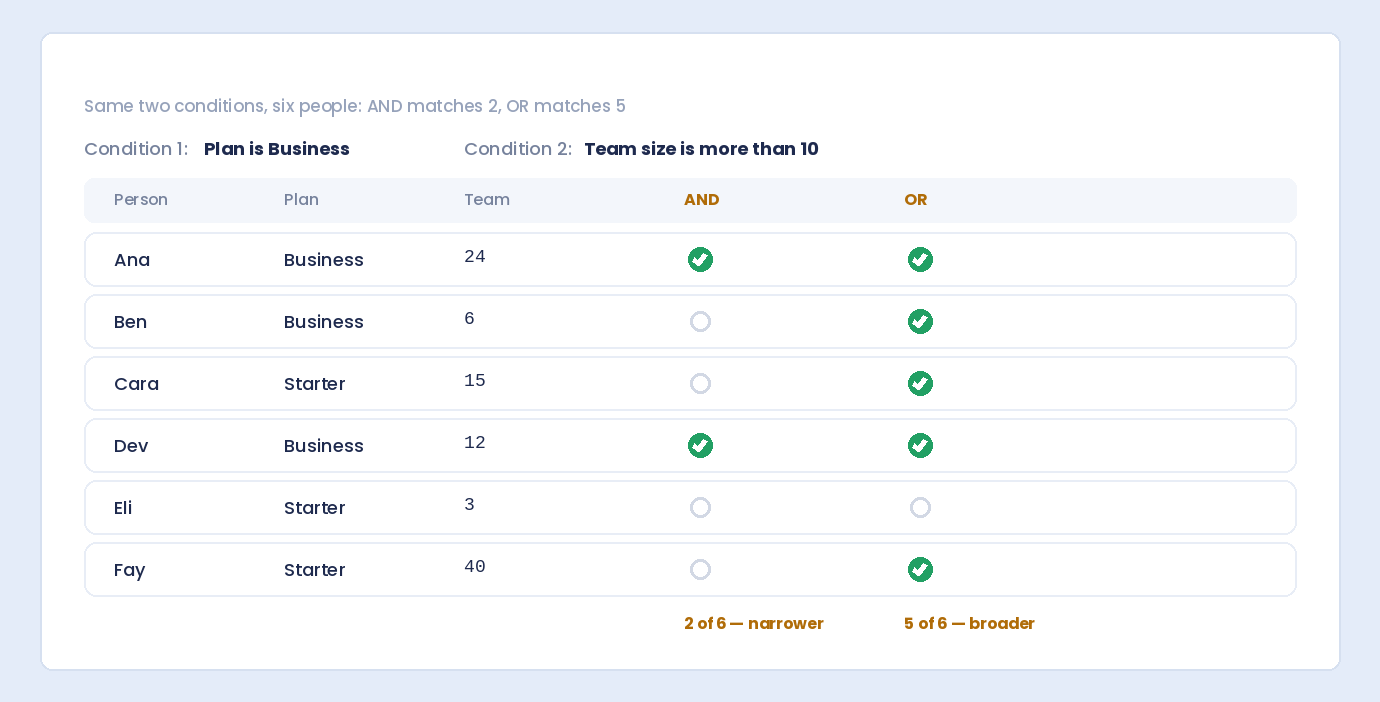
Quick Comparison

Logic Requirement Result
AND All conditions true More restrictive
OR Any condition true More inclusive

AND Logic in Detail

How AND Works

Condition A Condition B A AND B Result
True True ✅ True (field shows)
True False ❌ False (field hidden)
False True ❌ False (field hidden)
False False ❌ False (field hidden)

When to Use AND

  • Field requires multiple criteria to be relevant
  • Need to narrow down when field appears
  • Creating specific combinations
  • Reducing unnecessary fields

AND Examples

Example 1: Age + Activity

Show “Parental Consent” IF Age < 18 AND Activity = “Contact Sports”

Only minors in contact sports need consent.

Example 2: Country + Shipping

Show “State/Province” IF Country = “USA” AND Shipping = “Domestic”

Only US domestic shipping needs state.

Example 3: Membership + Quantity

Show “Bulk Discount Code” IF Member = “Yes” AND Quantity > 10

Only members ordering 10+ items see discount field.

Example 4: Service + Budget

Show “Premium Options” IF Service = “Custom” AND Budget > $5000

Premium upsells only for high-budget custom projects.

OR Logic in Detail

How OR Works

Condition A Condition B A OR B Result
True True ✅ True (field shows)
True False ✅ True (field shows)
False True ✅ True (field shows)
False False ❌ False (field hidden)

When to Use OR

  • Multiple triggers should show same field
  • Field applies to several categories
  • Creating inclusive conditions
  • Any of several situations applies

OR Examples

Example 1: Multiple Roles

Show “Student ID” IF Role = “Student” OR Role = “Faculty” OR Role = “Staff”

Anyone affiliated with institution needs ID.

Example 2: Contact Preference

Show “Phone Number” IF Contact = “Phone” OR Contact = “Text”

Either preference requires phone number.

Example 3: Special Handling

Show “Special Instructions” IF Order = “Fragile” OR Order = “Perishable” OR Order = “Hazardous”

Any special order type needs instructions.

Example 4: Eligibility

Show “Discount Application” IF Status = “Veteran” OR Status = “Senior” OR Status = “Student”

Multiple groups qualify for discounts.

Combining AND and OR

Complex Conditions

Real scenarios often need both:

Show field IF:
(Country = “USA” OR Country = “Canada”) AND Shipping = “Express”

Express shipping for North America only.

Order of Operations

Like math, logic has order of operations:

  • AND is evaluated before OR (usually)
  • Parentheses override order
  • Check your form builder’s specific behavior

Complex Example

Scenario: Show “Priority Support” field

Conditions:

  • Plan = “Enterprise” OR Plan = “Business”
  • AND
  • Issue = “Critical” OR Issue = “Urgent”

Logic:
(Plan = “Enterprise” OR Plan = “Business”) AND (Issue = “Critical” OR Issue = “Urgent”)

Priority support only for premium plans with urgent issues.

Setting Up Multiple Conditions

With Auto Form Builder’s Conditional Logic :

Step 1: Access Conditional Logic

  1. Select the field to conditionally show/hide
  2. Open conditional logic settings

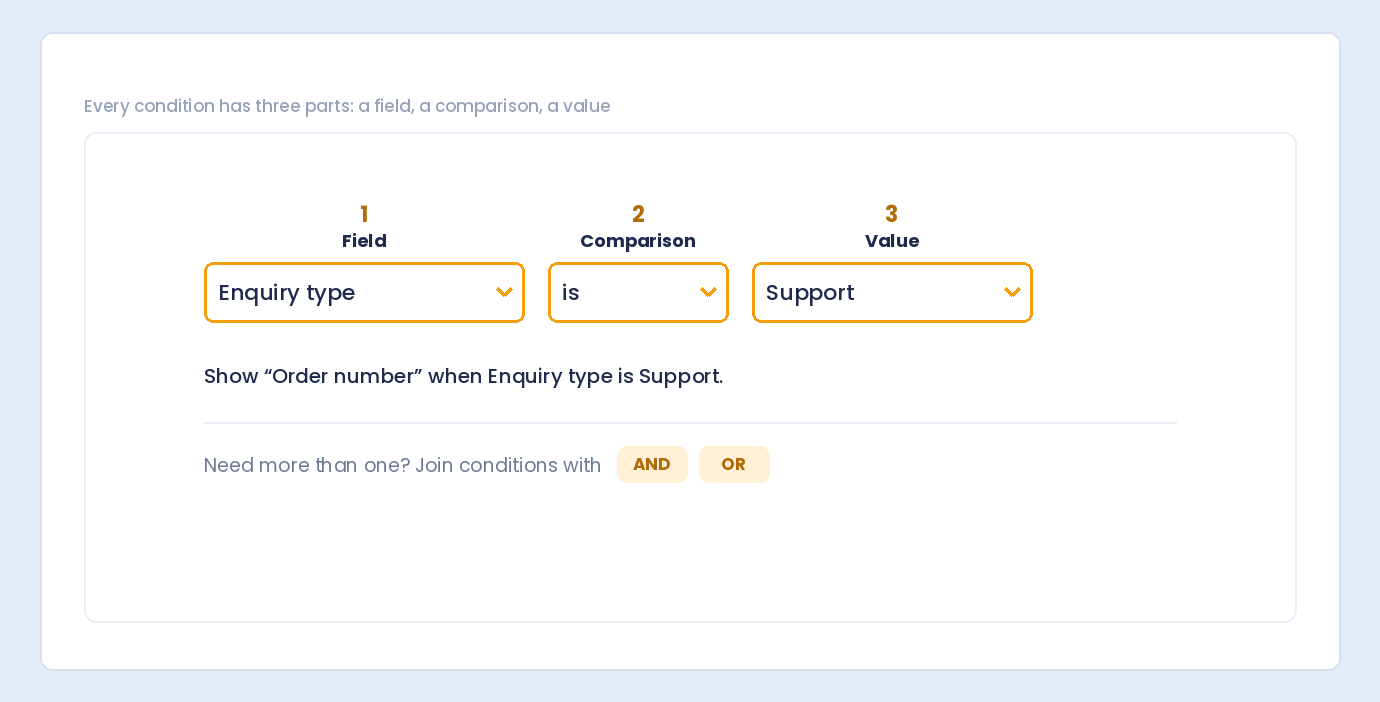
Step 2: Add First Condition

  1. Choose trigger field
  2. Select operator (equals, contains, etc.)
  3. Enter value to match

Step 3: Add Additional Conditions

  1. Click “Add Condition” or “+”
  2. Configure second condition
  3. Repeat for more conditions

Step 4: Choose AND or OR

  1. Select logic type between conditions
  2. AND = All must be true
  3. OR = Any can be true

Step 5: Test All Combinations

  1. Preview the form
  2. Test each condition combination
  3. Verify correct show/hide behavior

Real-World Scenarios

Scenario 1: Job Application

Position: Software Developer

Show “Years of Experience” IF:

  • Position = “Senior Developer” OR Position = “Lead Developer”

Show “Management Experience” IF:

  • Position = “Lead Developer” AND Team Size > 3

Scenario 2: Insurance Quote

Show “Additional Driver Details” IF:

  • Additional Drivers = “Yes” AND Number of Drivers > 1

Show “Young Driver Surcharge Notice” IF:

  • Driver Age < 25 OR License Years < 3

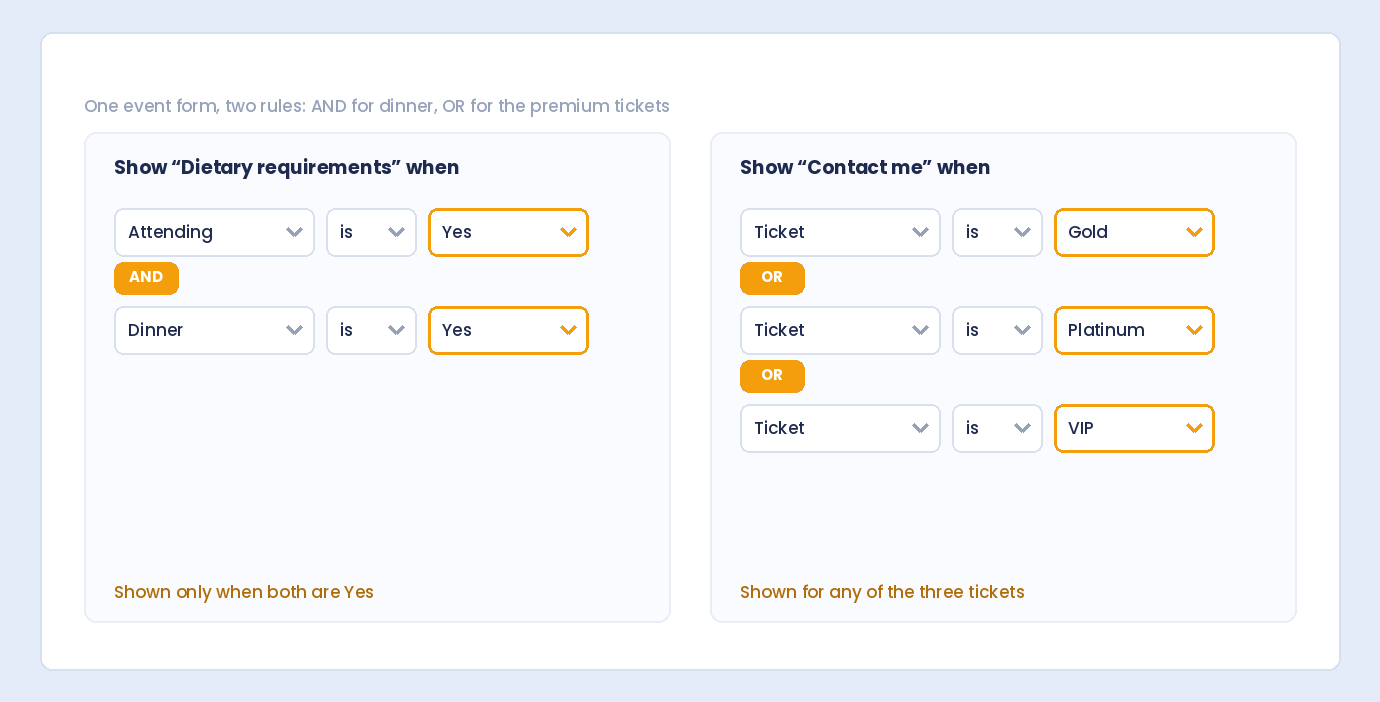
Scenario 3: Event Registration

Show “Dietary Requirements” IF:

  • Attending Lunch = “Yes” OR Attending Dinner = “Yes”

Show “VIP Parking Pass” IF:

  • Ticket Type = “VIP” AND Transportation = “Driving”

Scenario 4: Support Ticket

Show “Callback Number” IF:

  • Contact Method = “Phone” OR Priority = “Urgent”

Show “Account Manager Assignment” IF:

  • Account Type = “Enterprise” AND Issue Type = “Billing”

Scenario 5: Loan Application

Show “Co-signer Information” IF:

  • Credit Score < 650 OR Employment = “Self-employed” OR Loan Amount > $50000

Show “Collateral Details” IF:

  • Loan Type = “Secured” AND Loan Amount > $10000

Common Patterns

Pattern 1: Multiple Values (OR)

Same field, multiple acceptable values:

Show IF Country = "USA" OR Country = "Canada" OR Country = "Mexico"

Any North American country triggers the field.

Pattern 2: Dual Requirements (AND)

Two different fields must both match:

Show IF Account = "Premium" AND Support = "Priority"

Both conditions required.

Pattern 3: Category + Qualifier (AND)

Category selection plus additional criteria:

Show IF Category = "Electronics" AND Price > $500

High-value electronics only.

Pattern 4: Exception Handling (OR)

Field appears for multiple exception cases:

Show IF Status = "Exception" OR Status = "Pending Review" OR Status = "Flagged"

Any non-standard status triggers review field.

Pattern 5: Nested Groups

Combined logic with grouping:

Show IF (Type = "A" OR Type = "B") AND (Status = "Active")

Either type, but must be active.

Best Practices

1. Start Simple

Begin with single conditions, add complexity as needed:

  • Test single condition first
  • Add second condition
  • Test combination
  • Add more only if necessary

2. Document Your Logic

Complex conditions need documentation:

  • Write out the logic in plain English
  • Note which fields affect which
  • Create a logic map for complex forms

3. Test All Paths

With multiple conditions, combinations multiply:

  • 2 conditions = 4 combinations
  • 3 conditions = 8 combinations
  • 4 conditions = 16 combinations

Test them all!

4. Keep It Understandable

If logic is too complex:

  • Split into multiple forms
  • Simplify the requirements
  • Reconsider form structure

5. Consider User Experience

Complex logic affects users:

  • Fields appearing/disappearing can confuse
  • Too much branching feels chaotic
  • Balance functionality with simplicity

Troubleshooting Multiple Conditions

Field Never Appears

Check:

  • AND conditions—are all being met?
  • Impossible combinations?
  • Conflicting conditions?

Field Always Appears

Check:

  • OR conditions too broad?
  • Default values triggering conditions?
  • Condition logic inverted?

Unexpected Behavior

Check:

  • AND vs OR selected correctly?
  • Order of operations as expected?
  • Parentheses/grouping correct?

Debugging Steps

  1. Remove all but one condition—does it work?
  2. Add conditions back one at a time
  3. Test each addition
  4. Identify which condition causes issues

Performance Considerations

Keep Conditions Reasonable

  • More conditions = more processing
  • Dozens of conditions can slow forms
  • Aim for simplicity

Avoid Circular Dependencies

  • Field A controls Field B controls Field A
  • Can cause infinite loops
  • Keep logic flowing one direction

Frequently Asked Questions

What’s the difference between AND and OR?

AND requires ALL conditions to be true. OR requires ANY condition to be true. Use AND when you need multiple criteria met simultaneously. Use OR when any of several options should trigger the action.

Can I mix AND and OR in one rule?

Yes, but it gets complex. Use parentheses to group conditions and be clear about order of operations. Test thoroughly.

How many conditions can I have?

Technically, many—but practically, keep it under 5-6 conditions per field. More than that becomes hard to test and maintain.

Why doesn’t my field appear when it should?

With AND logic, check that ALL conditions are being met. One false condition hides the field. Test each condition individually to find the culprit.

Is conditional logic available in the free version?

In Auto Form Builder, conditional logic is a Pro add-on. The free version has all essential form features, with conditional logic available as an upgrade.

Summary

Using AND and OR logic in form conditions:

  1. AND – All conditions must be true (restrictive)
  2. OR – Any condition can be true (inclusive)
  3. Combine carefully – Use parentheses for complex logic
  4. Start simple – Add complexity gradually
  5. Test all combinations – Every path needs verification
  6. Document your logic – Complex rules need explanation
  7. Keep it manageable – Too complex defeats the purpose

Conclusion

AND and OR logic transform simple conditional fields into sophisticated, intelligent forms. AND narrows down when fields appear by requiring multiple criteria. OR expands possibilities by accepting any of several triggers. Combined thoughtfully, they create forms that adapt precisely to each user’s situation.

Auto Form Builder’s Conditional Logic add-on supports multiple conditions with AND/OR logic, letting you build forms as simple or complex as your needs require.

Ready for advanced conditional logic? Download Auto Form Builder and explore the Conditional Logic add-on for powerful multi-condition forms.

Leave a Reply

Your email address will not be published. Required fields are marked *