Date Format Guide: US vs UK vs International Dates
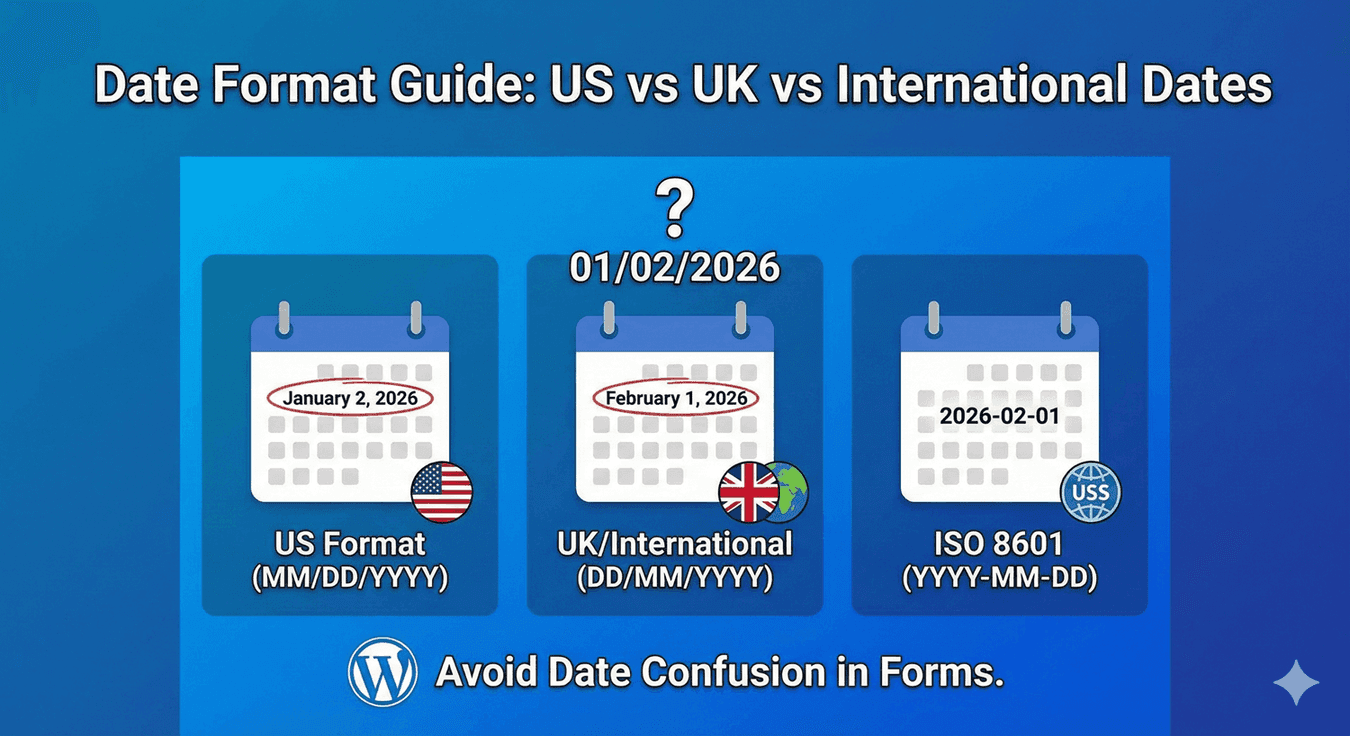
Is 01/02/2026 January 2nd or February 1st? Depends who you ask. In the US, it’s January 2nd. In the UK and most of the world, it’s February 1st. This simple difference causes endless confusion in forms.
In this guide, you’ll learn about different date formats, when to use each, and how to configure your WordPress forms to avoid date confusion.
The Date Format Problem
Same Numbers, Different Dates
| Written As | US Interpretation | UK/International |
|---|---|---|
| 01/02/2026 | January 2, 2026 | February 1, 2026 |
| 03/04/2026 | March 4, 2026 | April 3, 2026 |
| 05/06/2026 | May 6, 2026 | June 5, 2026 |
| 12/11/2026 | December 11, 2026 | November 12, 2026 |
One-third of all dates are ambiguous between formats. That’s a lot of potential confusion.
When It Goes Wrong
- Appointments booked on wrong day
- Event registrations for wrong date
- Reservations missed
- Data analysis errors
- Customer frustration
Major Date Format Standards
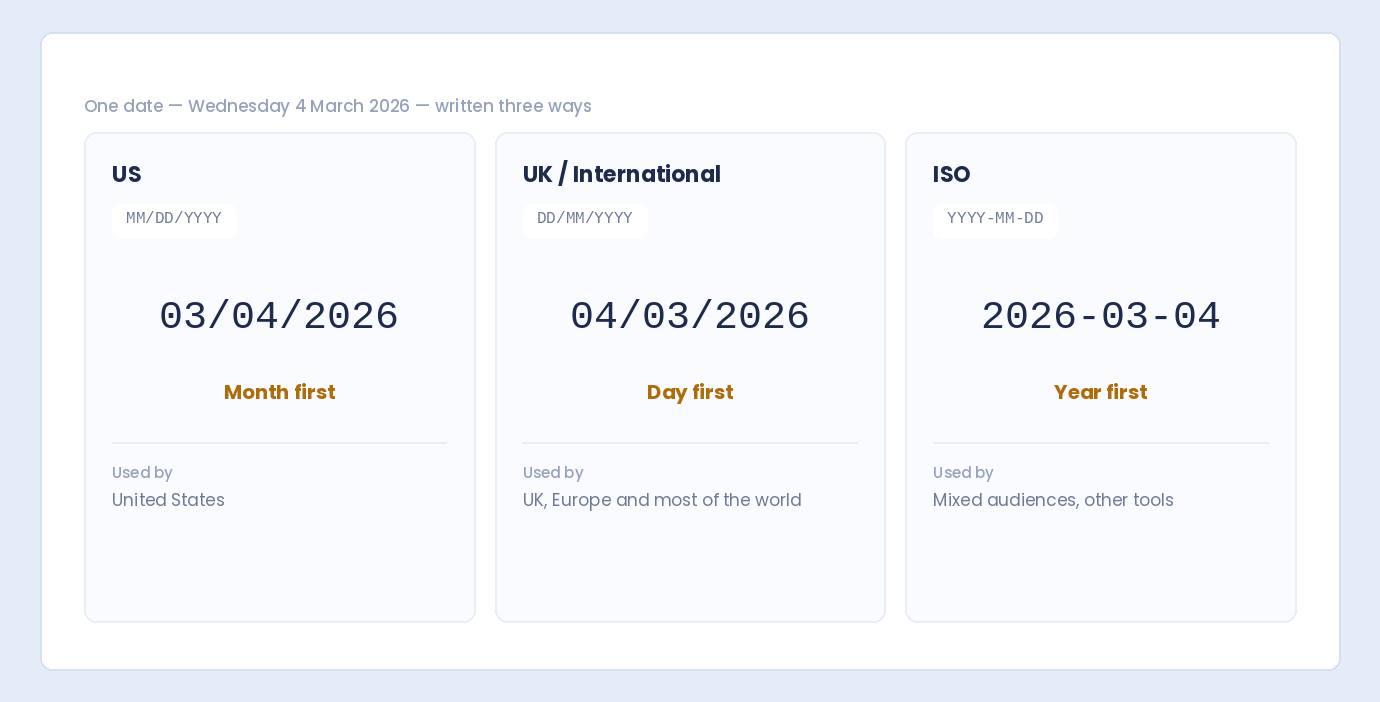
US Format: MM/DD/YYYY
Structure: Month / Day / Year
Example: 01/15/2026 = January 15, 2026
Used in:
- United States
- Some parts of Canada
- Philippines
- Palau, Micronesia
Pros:
- Familiar to US users
- Matches spoken “January 15th”
Cons:
- Confusing for international users
- Doesn’t sort chronologically
UK/European Format: DD/MM/YYYY
Structure: Day / Month / Year
Example: 15/01/2026 = January 15, 2026
Used in:
- United Kingdom
- Europe (most countries)
- Australia
- New Zealand
- India
- Most of Africa
- South America
- Middle East
Pros:
- Used by majority of world
- Logical small-to-large order (day → month → year)
Cons:
- Confusing for US users
- Still doesn’t sort chronologically
ISO Format: YYYY-MM-DD
Structure: Year – Month – Day
Example: 2026-01-15 = January 15, 2026
Used in:
- International standard (ISO 8601)
- China, Japan, Korea
- Hungary, Lithuania
- Sweden
- Canada (officially)
- Computing and databases
Pros:
- Unambiguous—can’t be misread
- Sorts chronologically
- International standard
- Best for databases and systems
Cons:
- Less intuitive for general users
- Feels “technical”
Date Format Comparison
| Format | Pattern | January 15, 2026 | December 3, 2026 |
|---|---|---|---|
| US | MM/DD/YYYY | 01/15/2026 | 12/03/2026 |
| UK/Europe | DD/MM/YYYY | 15/01/2026 | 03/12/2026 |
| ISO | YYYY-MM-DD | 2026-01-15 | 2026-12-03 |
| With dashes | DD-MM-YYYY | 15-01-2026 | 03-12-2026 |
| Long form | Month DD, YYYY | January 15, 2026 | December 3, 2026 |
Choosing the Right Format
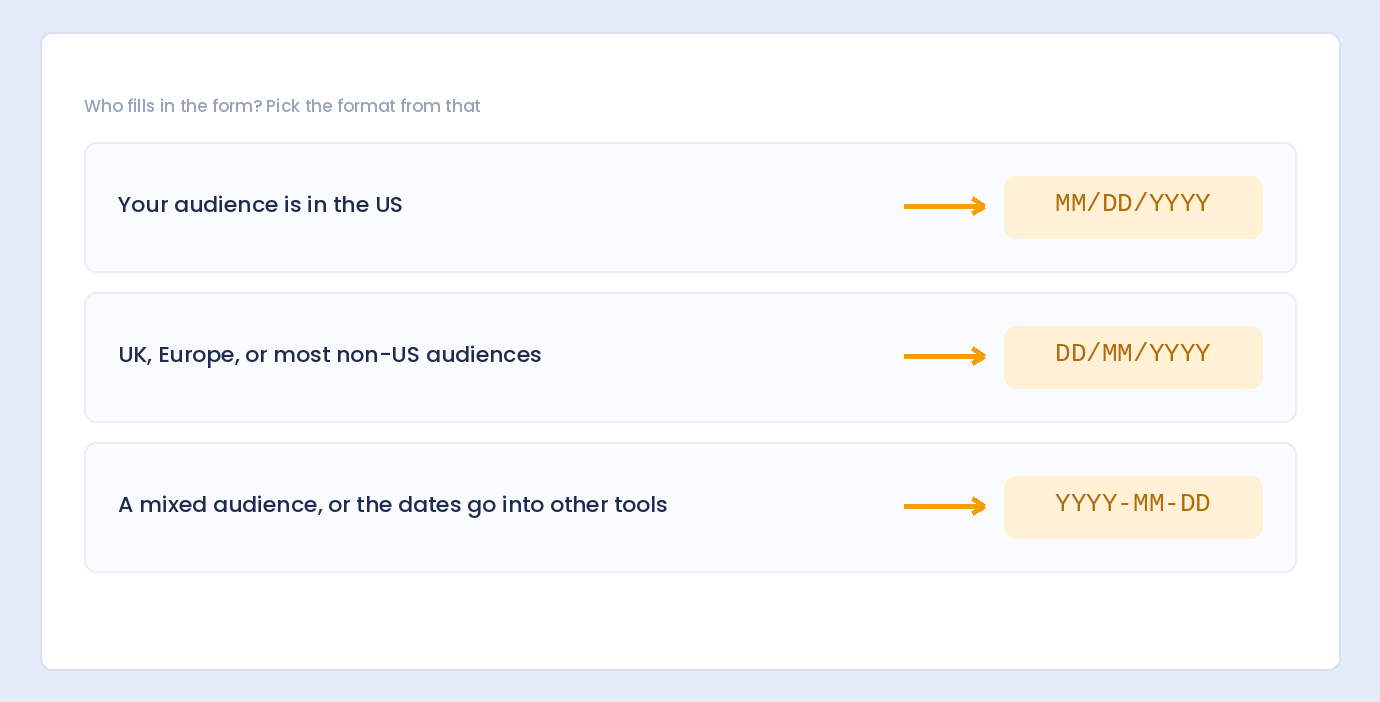
For US-Only Audience
Use: MM/DD/YYYY
Your audience expects this format. Using anything else may confuse them.
For UK/European Audience
Use: DD/MM/YYYY
Standard for this region. Matches user expectations.
For International/Global Audience
Best options:
- YYYY-MM-DD (ISO) – Unambiguous, professional
- Long format – “January 15, 2026” – Cannot be misread
- Date picker – Let users select visually, store in consistent format
For Mixed US/International
Avoid: Any numeric format that could be ambiguous
Use: Long format or ISO, or make the format very clear in labels
Configuring Date Formats in Forms
Here’s how to set date formats with Auto Form Builder:
Step 1: Install Auto Form Builder
- Go to Plugins → Add New
- Search for “AFB” (the short name for Auto Form Builder)
- Find “AFB – Auto Form Builder – Drag & Drop Form Creator“
- Click Install Now, then Activate
Step 2: Add a Date Field
- Create or edit your form
- Drag the Date field onto your form
- Click to open field settings
Step 3: Select Date Format
Choose from available formats:
- MM/DD/YYYY – US format
- DD/MM/YYYY – UK/European format
- YYYY-MM-DD – ISO international format
- DD-MM-YYYY – Alternative European
Step 4: Add Format Hint
Include help text showing the expected format:
- “Date format: MM/DD/YYYY”
- “Enter date as DD/MM/YYYY”
- “Format: YYYY-MM-DD”
Or use placeholder text showing an example: “01/15/2026”
Best Practices for Date Fields
1. Use Date Pickers
Visual calendars eliminate format confusion:
- Users click to select
- System stores in consistent format
- No typing errors
- Format displayed matches your setting
2. Show the Format
If allowing manual entry, show expected format:
- In placeholder text
- In help text below field
- In the label if needed
3. Match Your Audience
Know where your users are:
- US site for US business = US format
- UK site for UK customers = UK format
- Global site = ISO or long format
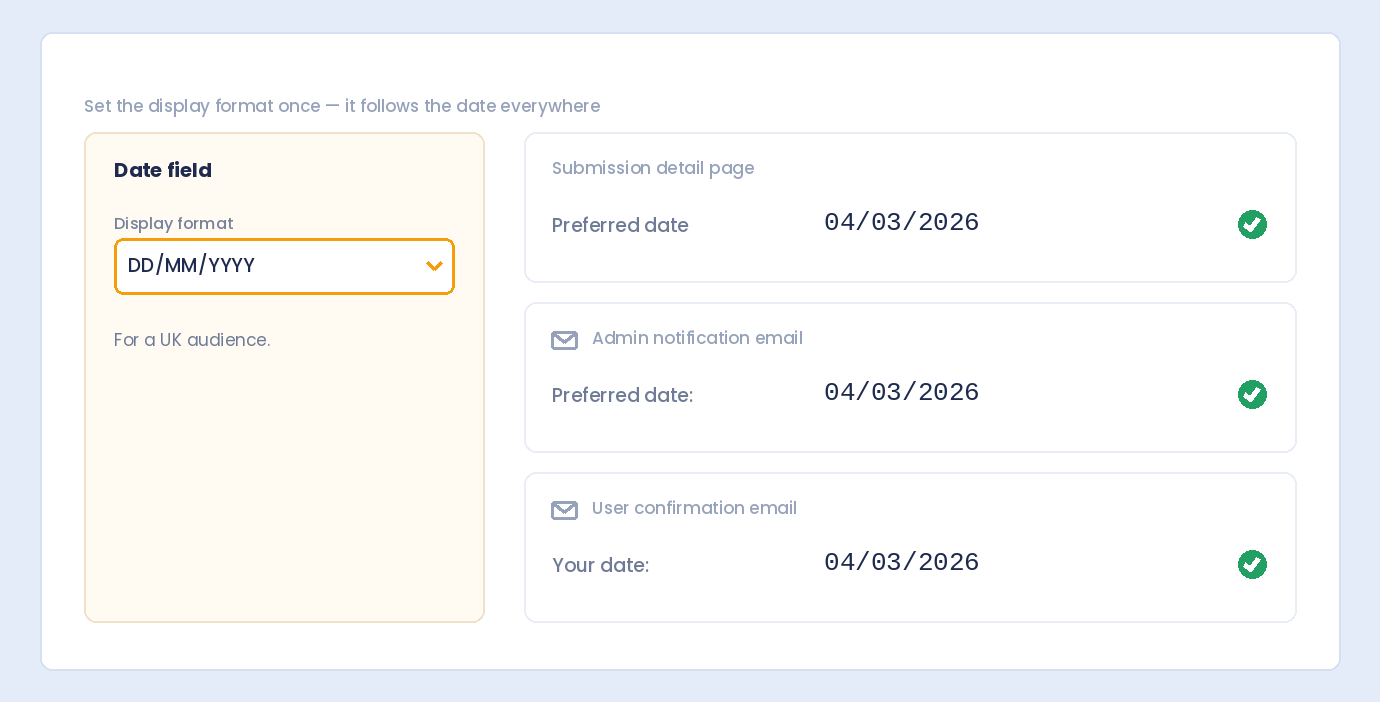
4. Be Consistent
Use the same format throughout:
- All forms on your site
- Email confirmations
- Submission displays
- Exports and reports
5. Store in Standard Format
Regardless of display format, store dates in ISO format (YYYY-MM-DD) in your database. This ensures:
- Proper sorting
- Easy conversion
- No ambiguity in stored data
6. Consider Long Format for Confirmation
After submission, show dates in unambiguous long format:
- Input: 01/15/2026
- Confirmation: “January 15, 2026”
Handling Multiple Regions
Option 1: Single International Format
Use ISO (YYYY-MM-DD) for everyone:
- Consistent across all users
- No regional confusion
- May feel unfamiliar to some
Option 2: Detect User Location
Show format based on user’s location:
- US visitors see MM/DD/YYYY
- UK visitors see DD/MM/YYYY
- Requires geo-detection
- More complex to implement
Option 3: Let Users Choose
Add a region/country field first:
- Adjust date format based on selection
- User controls their experience
Option 4: Always Use Long Format
Display dates as “January 15, 2026”:
- Cannot be misinterpreted
- Works for everyone
- Takes more space
Date Formats by Country
MM/DD/YYYY (Month First)
- United States
- Philippines
- Palau
- Micronesia
- Parts of Canada
DD/MM/YYYY (Day First)
- United Kingdom
- Ireland
- Germany
- France
- Spain
- Italy
- Australia
- New Zealand
- India
- Brazil
- Argentina
- Mexico
- Most of Europe
- Most of South America
- Most of Africa
- Middle East
YYYY-MM-DD (Year First)
- China
- Japan
- South Korea
- North Korea
- Taiwan
- Hungary
- Lithuania
- Sweden (often)
- Canada (officially)
- Iran
Common Mistakes to Avoid
Mistake 1: Assuming Everyone Uses Your Format
US businesses often assume MM/DD/YYYY is universal. It’s not—most of the world uses DD/MM/YYYY.
Mistake 2: No Format Indication
A date field with no hint about format invites confusion. Always show expected format.
Mistake 3: Mixing Formats
Using MM/DD/YYYY in forms but DD/MM/YYYY in emails creates confusion. Be consistent.
Mistake 4: Ambiguous Examples
Bad placeholder: “01/02/2026” (ambiguous)
Good placeholder: “12/25/2026” (clearly December 25)
Use dates where the day is >12 to make format obvious.
Mistake 5: Not Testing Internationally
Test your forms with users from different regions to catch format confusion.
Separator Styles
Dates use different separators:
Slashes (/)
- 01/15/2026
- Most common in US and UK
Dashes (-)
- 2026-01-15
- Common in ISO format
- Used in many European countries
Periods (.)
- 15.01.2026
- Common in Germany, Russia, other European countries
Spaces
- 15 01 2026
- Less common, sometimes seen
Recommendation: Stick with slashes (/) or dashes (-) for clarity.
Two-Digit vs Four-Digit Years
Two-Digit Years (YY)
- 01/15/26
- Shorter
- Ambiguous (1926? 2026? 2126?)
- Not recommended
Four-Digit Years (YYYY)
- 01/15/2026
- Unambiguous
- Industry standard
- Always use four digits
Date Validation
Format Validation
Ensure entered dates match expected format:
- Correct number of digits
- Proper separators
- Valid month (1-12)
- Valid day for month (1-31, accounting for month)
Logical Validation
Check that dates make sense:
- February 30 doesn’t exist
- February 29 only in leap years
- Month not >12
- Day not >31
Date Pickers Handle This
Visual date pickers prevent invalid dates automatically—one more reason to use them.
Frequently Asked Questions
What date format should I use for a global audience?
Use ISO format (YYYY-MM-DD) or long format (January 15, 2026). Both are unambiguous and understood worldwide.
Why does the US use a different date format?
The US format (MM/DD/YYYY) mirrors how Americans speak dates: “January 15th, 2026” = “1/15/2026.” Most other countries order by size: day (small) → month (medium) → year (large).
Is DD/MM/YYYY or MM/DD/YYYY more common globally?
DD/MM/YYYY is used by the majority of the world. MM/DD/YYYY is primarily used in the United States and a few other countries.
What is the ISO date format?
ISO 8601 specifies YYYY-MM-DD (e.g., 2026-01-15). It’s the international standard, unambiguous, and sorts chronologically. It’s ideal for databases and international use.
How do I avoid date confusion in forms?
Use date pickers (visual calendars), show the expected format in labels or help text, and display confirmed dates in long format (e.g., “January 15, 2026”).
Should I use two-digit or four-digit years?
Always use four-digit years (2026, not 26). Two-digit years are ambiguous and can cause Y2K-style confusion.
Summary
Choosing the right date format:
- Know your audience – US, UK, or international
- Select appropriate format – MM/DD/YYYY, DD/MM/YYYY, or YYYY-MM-DD
- Use date pickers – Eliminates typing and format errors
- Show expected format – In placeholder or help text
- Be consistent – Same format everywhere
- Use four-digit years – Always YYYY, never YY
- Consider long format – For confirmations and mixed audiences
Conclusion
Date format confusion is entirely preventable. Know your audience, pick the right format, and make it clear to users. For global audiences, ISO format or written-out dates eliminate ambiguity completely.
Auto Form Builder lets you choose your date format and combines it with visual date pickers that prevent format confusion. Users select dates visually; the system stores them consistently.
Ready to configure date fields properly? Download Auto Form Builder and set the right date format for your audience.